
Reviewed November 22, 2026.
The short version
From FY2018 through FY2024, Texas public colleges waived $1.17 billion in Hazlewood Legacy tuition and fees for the children of Texas veterans. The state reimbursed $259 million of it. Institutions absorbed the other $910 million.
The numbers
For six straight years the state covered about 14 cents of every Hazlewood Legacy dollar its colleges waived. In FY2024 that jumped to 74 cents after the 88th Legislature added roughly $107 million a year in General Revenue, according to the Legislative Budget Board.
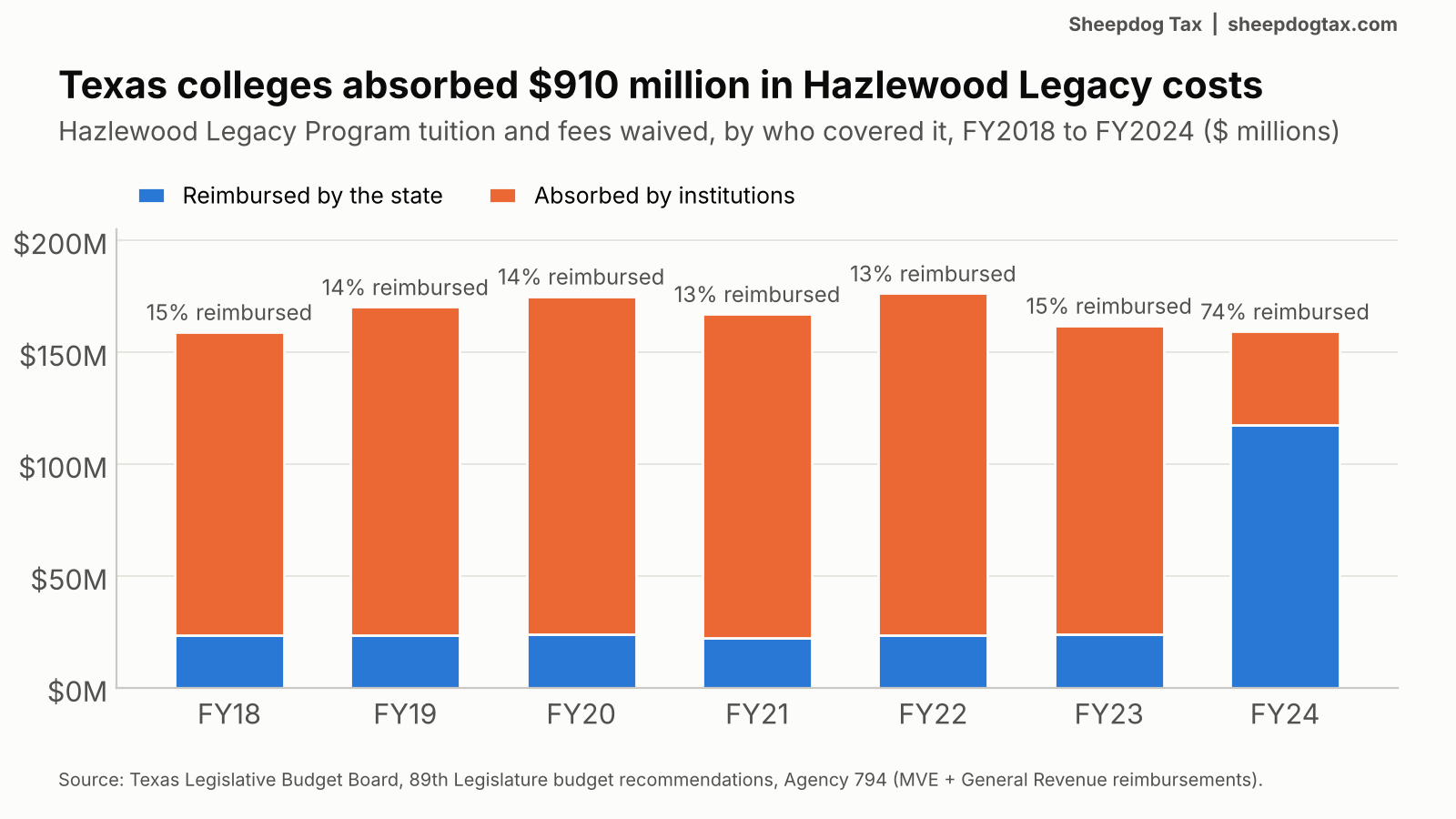
| Fiscal year | Legacy tuition and fees waived | State reimbursement (MVE + GR) | Share reimbursed | Absorbed by institutions |
|---|---|---|---|---|
| FY2018 | $159.1M | $23.6M | 14.9% | $135.5M |
| FY2019 | $170.3M | $23.7M | 13.9% | $146.5M |
| FY2020 | $175.0M | $23.8M | 13.6% | $151.2M |
| FY2021 | $167.2M | $22.4M | 13.4% | $144.8M |
| FY2022 | $176.4M | $23.5M | 13.3% | $152.8M |
| FY2023 | $162.0M | $24.1M | 14.9% | $137.8M |
| FY2024 | $159.4M | $117.7M | 73.9% | $41.7M |
| Total | $1,169.3M | $259.0M | 22.1% | $910.3M |
The Hazlewood Act provides up to 150 semester credit hours of tuition exemption, including most mandatory fees, and the Legacy Program lets a qualifying veteran transfer unused hours to a child, as Texas A&M University-Kingsville summarizes it. Legacy is the expensive part of Hazlewood: in 2015 Legacy students were more than 56% of recipients and received nearly 70% of the exemption’s value, according to the Texas Comptroller.
Why it matters
An unfunded benefit is still a benefit, but someone pays for it. Before FY2024 that someone was mostly the institution, and some campus leaders have said the cost flowed through to other students’ tuition.
- For veterans and their children: the benefit itself did not change. A qualifying child still receives up to 150 hours of tuition and most fees at a Texas public institution. What changed in FY2024 is how secure that promise looks on a college’s balance sheet.
- For institutions: the gap fell from about $145 million a year (FY2018 to FY2023 average) to $41.7 million in FY2024. It did not go to zero, and campuses with large veteran-family enrollments still carry the remainder. The Texas A&M University System launched its own program for 2026-27 to cover unreimbursed Hazlewood costs at its campuses.
- For the budget: the 89th Legislature’s recommendations held General Revenue for the Legacy Program at $214.9 million for 2026-27, the same as 2024-25. If Legacy usage grows and the appropriation stays flat, the reimbursement share will drift down again.
My view (opinion): the FY2024 funding was the right fix, but it is an appropriation, not a formula. A benefit promised to every qualifying veteran family should be funded by a mechanism that scales with usage.
Method and limits
Every figure comes from the Legislative Budget Board’s 89th Legislature budget recommendations for the Permanent Fund Supporting Military and Veterans Exemptions (Agency 794), cross-checked against the 88th Legislature edition for FY2018 to FY2022.
- Waived dollars are Legacy Program only. Veteran, spouse and dependent Hazlewood exemptions are excluded, so total Hazlewood cost is higher.
- Reimbursement is MVE fund distributions plus General Revenue, by fiscal year as the LBB reports them. Distributions are based on the prior year’s Texas Veterans Commission data.
- Absorbed means waived minus reimbursed. It is the gross revenue institutions forgo, not a measure of what each campus passed on to other students.
- FY2025 waived dollars were not yet published in the LBB summary. The Texas A&M University System reported that state funding covered about 67% of Legacy costs on FY2025 data.
Related reading
- Part 2: Where Texas veterans build jobs
- Part 3: What each branch earns in Texas
- All Texas Veterans research
For a scoped engagement inquiry, email Noah Green with a short description of the issue and any upcoming deadline. Do not send tax returns, identifying numbers or other sensitive records through ordinary email. Secure document instructions follow separately. Payment and your signature may initiate an engagement request; they do not mean the case has been accepted. I review the facts after payment and must countersign the engagement letter and accept the case before work begins. The accepted written engagement governs scope.
This article provides general information drawn from public data, not tax, legal or financial advice for your specific facts. No outcome is guaranteed.
Sources
- Legislative Budget Board, 89th Legislature, Agency 794: waived dollars and reimbursements, FY2018 to FY2027
- Legislative Budget Board, 88th Legislature, Agency 794: FY2018 to FY2022 cross-check
- Texas Comptroller, Fiscal Notes: Hazlewood (2016): Legacy share of recipients and value
- Texas A&M University-Kingsville, September 2026: benefit terms, A&M System initiative and FY2025 reimbursement
Prepared by Noah Green, CPA, CFE, CTRS.