
Texas Veterans series, Part 3
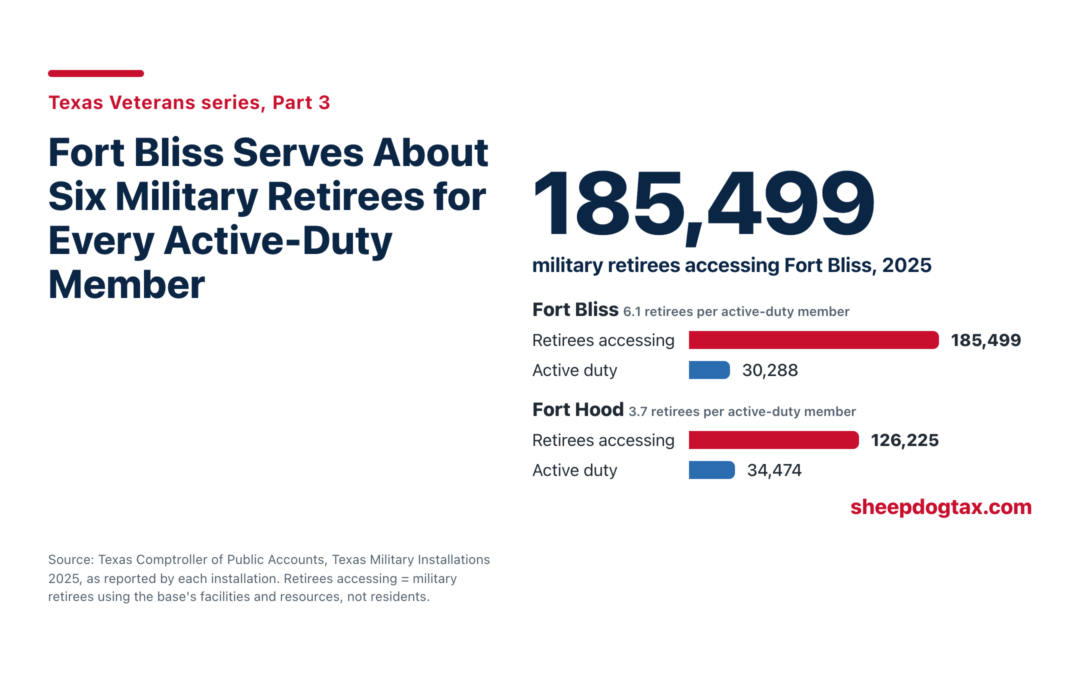
In 2025, Fort Bliss reported 185,499 military retirees using its facilities and resources, about six for every one of its 30,288 active-duty personnel, according to the Texas Comptroller. Fort Hood reported 126,225 retirees, 34,474 active-duty personnel and 44,438 dependents.
When people picture an Army post, they picture the troops stationed there. The numbers Texas installations report to the state tell a bigger story. For every active-duty member at Fort Bliss, about six military retirees use the base.
This is Part 3 of the Texas Veterans series. Part 1 counted veterans; Part 2 followed VA dollars. This part looks at the installations themselves, using the Texas Comptroller of Public Accounts’ 2025 study of the state’s 14 military installations.
The numbers behind the gate
As of 2025, Fort Bliss had 30,288 active-duty military personnel and 18,492 dependents. It also reported 185,499 military retirees accessing the installation’s facilities and resources. That is 6.1 retirees for every active-duty member. (Source: Texas Comptroller, Texas Military Installations 2025: Fort Bliss)
Fort Hood reported 34,474 active-duty personnel, 44,438 dependents and 126,225 military retirees accessing the installation: 3.7 retirees for every active-duty member. (Source: Texas Comptroller, Texas Military Installations 2025: Fort Hood)
| Installation | Active duty | Dependents | Military retirees accessing | Retirees per active-duty member |
|---|---|---|---|---|
| Fort Bliss | 30,288 | 18,492 | 185,499 | 6.1 |
| Fort Hood | 34,474 | 44,438 | 126,225 | 3.7 |
(Source for every row: Texas Comptroller, Texas Military Installations 2025, installation pages, as reported by each installation. The ratio divides the two published counts.)

What “accessing” means, and what it does not
The Comptroller and the Texas Military Preparedness Commission collected these figures from each installation. The retiree line counts military retirees who use an installation’s “facilities or resources (e.g. hospitals, PX’s, Exchanges, etc.),” in the survey’s own words. (Source: Texas Comptroller, Texas Military Installations 2025: T2COM, which prints the survey line in full.) Fort Bliss, for example, is home to William Beaumont Army Medical Center, according to its Comptroller page.
Three limits keep the numbers honest:
- It is not where retirees live. The count says how many retirees use the base. It does not say how many live in El Paso or in Bell County, and this article does not claim either.
- It does not add up across bases. A retiree may use more than one installation, so the figures are not combined into a statewide total.
- Military retirees are a subset of veterans. These are not veteran counts. Part 1 of this series counted all veterans, using a different federal source.
Beyond the two Army posts
Six of Texas’s 14 installations reported a retiree figure for 2025. (Source: Texas Comptroller installation pages, 2025)
- NAS Joint Reserve Base Fort Worth reported “40,000-plus” military retirees accessing the installation, alongside 2,175 active-duty personnel.
- NAS Kingsville, a naval aviation training base, reported 16,227 retirees and 660 active-duty personnel.
- Goodfellow Air Force Base reported 4,000 retirees and 5,516 active-duty personnel.
- Sheppard Air Force Base reported 978 retirees. Its personnel figure, 1,963, is stated as active-duty military, National Guard and/or reserve.
The other eight did not report a positive number. Joint Base San Antonio, with 33,256 active-duty personnel, published no retiree figure, so this article does not estimate one. T2COM reported zero.
Small bases produce large ratios. NAS Kingsville’s 16,227 retirees and 660 active-duty personnel work out to more than 24 retirees per active-duty member. That says more about the size of the training command than about the retiree community, which is why the comparison above uses Fort Bliss and Fort Hood.

The economic weight of the two posts
The Comptroller also estimates each installation’s contribution to the Texas economy. For Fort Hood, it puts economic output at $37.9 billion ($37,872,796,000) in 2025, with 159,692 total jobs, direct and indirect. For Fort Bliss, output was $29.1 billion ($29,090,546,000), with 121,220 total jobs. (Sources: Comptroller pages for Fort Hood and Fort Bliss, Exhibit 1)
Part 4 of this series covers all 14 installations and the statewide total.
VA dollars in the host counties: a separate source
The installation counts above come from the Comptroller. VA keeps its own accounting of where its dollars go, by county, which Part 2 covered in detail. The two sources are not combined here.
In federal fiscal year 2025, $1.07 billion ($1,067,091,213) in VA direct benefits was attributed to El Paso County, home to Fort Bliss. Bell and Coryell counties, where Fort Hood is located, had $1.66 billion combined: $1.41 billion in Bell and $251 million in Coryell. (Source: U.S. Department of Veterans Affairs, Geographic Distribution of VA Expenditures (GDX), FY2025, County Direct Exp)
These are county totals. They cannot be split by base or by retiree status, and nothing here is computed “per retiree.”

All 14 installations
The table below lists every installation in the Comptroller’s 2025 study, with the active-duty, dependent and retiree figures each one reported. Sort by any column.

What these numbers do and do not say
They show use, not residence. Retiree counts measure who uses an installation. A count of military retirees by where they live would need a different source, and none is used here.
They are reported by the installations. Eight of 14 did not report a positive retiree figure, so any statewide picture from this data is incomplete.
They do not explain choices. The data do not say why retirees use a particular base, or why anyone settles near one.
A note on names
The Comptroller’s 2025 study uses “Fort Hood.” The post was named Fort Cavazos in 2023 and returned to the Fort Hood name in July 2025, this time honoring Col. Robert B. Hood. (Source: Texas Comptroller, Texas Military Snapshot 2025, notes)
What comes next
Part 4 adds up the economic footprint of all 14 installations from the same Comptroller study. Part 5 returns to VA’s county data, comparing Bell County with Dallas County.
Methods and caveats
- Sources. Texas Comptroller of Public Accounts, Texas Military Installations 2025: the installation pages (https://comptroller.texas.gov/economy/economic-data/military/2025/) and the statewide snapshot. The figures were collected with the Texas Military Preparedness Commission from each installation. Separately, U.S. Department of Veterans Affairs, Geographic Distribution of VA Expenditures (GDX), FY2025, County Direct Exp. Retrieved Nov. 22, 2026.
- Retirees “accessing.” Military retirees accessing the installation, camp facilities and resources (for example hospitals and exchanges), as reported by each installation. Not a residence count. A retiree may use more than one installation, so counts are never added into a statewide total.
- Missing reports. Seven installations, including Joint Base San Antonio, reported no retiree figure; T2COM reported zero. None is estimated.
- Lower bound. NAS Joint Reserve Base Fort Worth reported “40,000-plus”; charts show it as 40,000+.
- Ratios. Retirees per active-duty member divides the two counts printed on each installation’s page (Fort Bliss 6.1, Fort Hood 3.7). Small active-duty counts produce large ratios.
- Sheppard AFB. Its 1,963 is stated as active-duty military, National Guard and/or reserve.
- Economic estimates. Output and total jobs (direct and indirect) are the Comptroller’s model estimates (Exhibit 1 on each installation page).
- VA dollars. GDX county totals, attributed to counties; not split by installation or retiree status; not combined with the Comptroller’s counts.
- Military retirees and veterans. Military retirees are a subset of veterans; these are not veteran counts.
- No residence data. No Defense Department count of retirees by state of residence is used.
Frequently asked questions
Is the Fort Bliss figure a count of where retirees live?
No. Fort Bliss reported 185,499 military retirees accessing the installation’s facilities and resources. That is a count of use, not of residence, and the data do not say how many retirees live in El Paso.
Can I add up the retiree numbers for all the bases?
No. A retiree may use more than one installation, and eight of the 14 did not report a positive figure, so a sum would double-count some people and miss others.
Why is Joint Base San Antonio missing?
Its Comptroller page lists 33,256 active-duty personnel but no retiree figure. This article does not estimate one.
Are military retirees the same as veterans?
No. Military retirees are a subset of veterans. Part 1 of this series counted all Texas veterans using a different federal source.
Why does NAS Kingsville show more than 24 retirees per active-duty member?
It is a small training command: 660 active-duty personnel and 16,227 retirees accessing the base. A small denominator makes a large ratio.
Is the $1.66 billion in Bell and Coryell counties spent on Fort Hood’s retirees?
That cannot be said from the data. VA’s GDX figures are county totals attributed to each county. They are not split by installation or by whether a veteran is a military retiree.
Isn’t it Fort Cavazos?
It was from 2023 until July 2025, when the post returned to the Fort Hood name, now honoring Col. Robert B. Hood. The Comptroller’s 2025 study uses “Fort Hood.”
Can I check the numbers?
Yes. Each interactive chart has a “Download data (CSV)” button with the figures it shows and the source page for each installation.
Sources
- Texas Comptroller of Public Accounts, Texas Military Installations 2025, installation pages. https://comptroller.texas.gov/economy/economic-data/military/2025/. Retrieved Nov. 22, 2026.
- Texas Comptroller of Public Accounts, Texas Military Snapshot 2025. https://comptroller.texas.gov/economy/economic-data/military/2025/statewide-snapshot.php. Retrieved Nov. 22, 2026.
- U.S. Department of Veterans Affairs, Geographic Distribution of VA Expenditures, FY2025 workbook. https://www.va.gov/vetdata/docs/GDX/GDX_FY25.xlsx. Retrieved Nov. 22, 2026.
General information, not tax advice. Your situation may differ.