
Reviewed November 22, 2026.
The short version
Enlisted veterans working in Texas earn a median $40,000 to $53,000 in their first year out of uniform. Ten years out, every branch’s median clears the $58,229 Texas full-time worker median, led by the Coast Guard and Air Force at about $78,000.
The numbers
Air Force and Coast Guard veterans start highest, but Marines climb fastest: their median rises 81% between year 1 and year 10. Every branch earns more in Texas at year 10 than its national median, based on Census Veteran Employment Outcomes data.
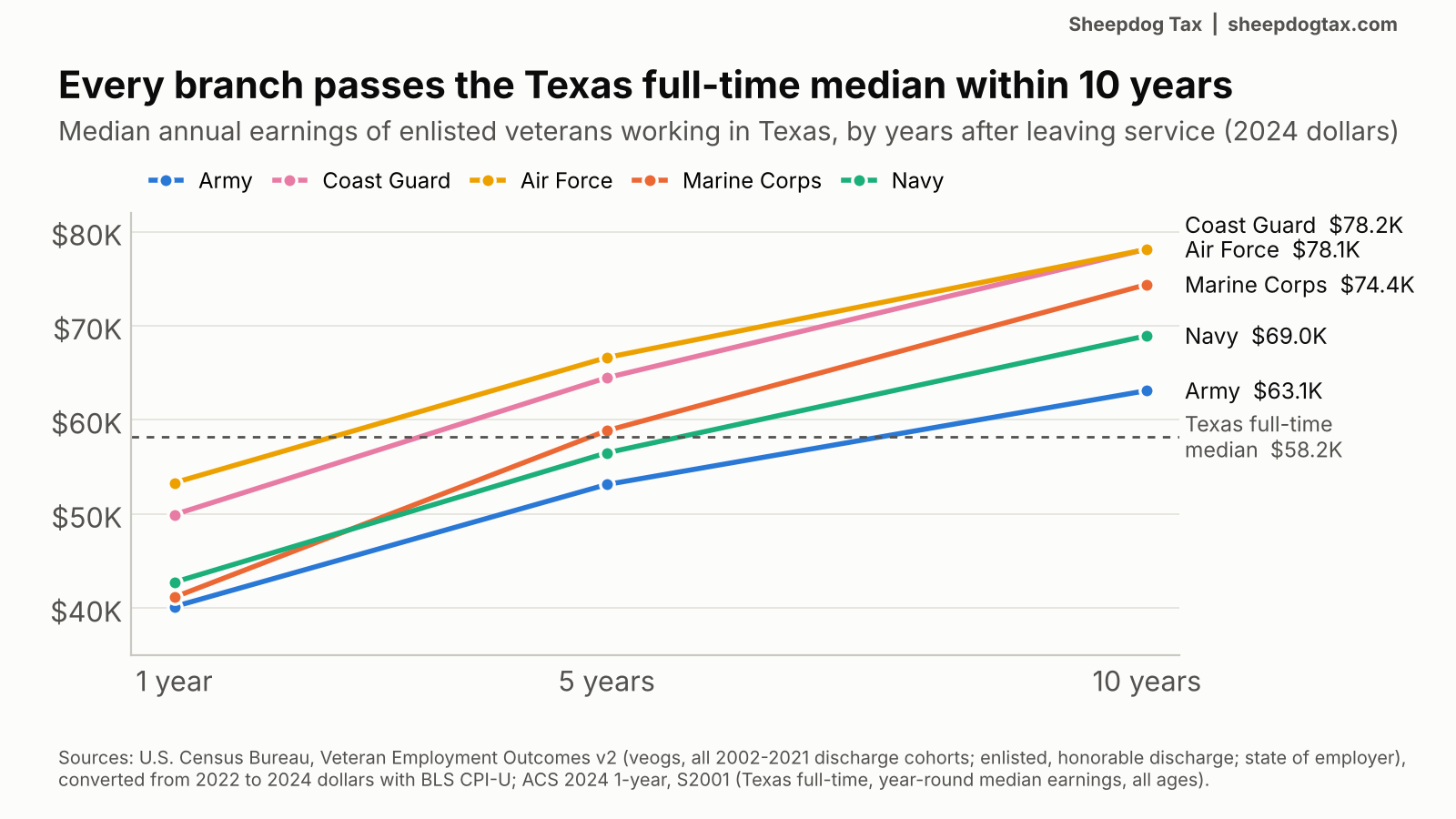
| Branch | Year 1 | Year 5 | Year 10 | Growth, year 1 to 10 | Year 10 vs national median | Veterans employed in Texas, year 1 |
|---|---|---|---|---|---|---|
| Coast Guard | $49,939 | $64,484 | $78,161 | +57% | +9.6% | 1,750 |
| Air Force | $53,326 | $66,628 | $78,140 | +47% | +2.9% | 30,710 |
| Marine Corps | $41,160 | $58,857 | $74,399 | +81% | +6.9% | 24,230 |
| Navy | $42,757 | $56,498 | $68,954 | +61% | +0.6% | 27,850 |
| Army | $40,163 | $53,133 | $63,123 | +57% | +5.4% | 77,290 |
| All branches | $42,918 | $57,163 | $68,932 | +61% | +3.2% | 161,800 |
Median annual earnings in 2024 dollars for enlisted veterans honorably discharged 2002 to 2021 and working for a Texas employer.
Veterans versus civilians, all ages
Across all ages, Texas veterans report a median income of $59,560 against $40,471 for nonveterans, a 47% gap that ranks 8th among the 50 states and DC.
| State | Veterans, median income | Nonveterans, median income | Veteran premium |
|---|---|---|---|
| Alabama (highest) | $57,473 | $35,337 | +63% |
| Virginia | $71,871 | $45,389 | +58% |
| Texas | $59,560 | $40,471 | +47% |
| Nevada | $54,139 | $40,502 | +34% |
This compares people, not branches: the ACS veteran tables (S2101) report period of service, not branch. Veterans skew older and male, and income here includes pensions and VA disability compensation, so the gap overstates any pure earnings advantage.
Why it matters
The first year out is the trough. Army, Marine and Navy veterans start about $15,000 to $18,000 below the Texas full-time median. Marines pass it by year 5; Army and Navy veterans pass it between year 5 and year 10.
- For separating service members: budget for the first-year dip. Terminal leave, a gap between jobs and a move can all land in the same tax year.
- For employers: veterans’ earnings keep climbing a decade out, a sign of skills the market rewards over time.
- For tax planning: rising wages after separation, VA disability compensation (not included in income) and military retirement pay based on age or length of service (taxable), as IRS Publication 525 explains, mix in ways that change withholding and estimated tax needs year to year.
My view (opinion): economic impact claims about veterans usually lean on multiplier models. Earnings over time, measured from employer wage records like these, are the more defensible number to put in front of a client, a lender or a legislator.
Method and limits
Branch figures come from Census Veteran Employment Outcomes (VEO), which links Department of Defense service records to state unemployment insurance wage records.
- Coverage: enlisted veterans, ranks E1 to E9, honorably discharged 2002 to 2021 from the Army, Navy, Air Force, Marine Corps and Coast Guard. Officers and Space Force are excluded.
- Texas means the state of the veteran’s main employer, not residence. All discharge cohorts are pooled.
- Earnings exclude self-employment and veterans with two or more quarters without earnings. VEO reports 2022 dollars, converted here to 2024 dollars with the BLS CPI-U annual average (313.689 / 292.655).
- The Texas benchmark is the ACS 2024 median for full-time, year-round workers of all ages: a broad yardstick, not an age-matched control.
Related reading
- Part 1: The Hazlewood Legacy bill Texas colleges paid
- Part 2: Where Texas veterans build jobs
- All Texas Veterans research
For a scoped engagement inquiry, email Noah Green with a short description of the issue and any upcoming deadline. Do not send tax returns, identifying numbers or other sensitive records through ordinary email. Secure document instructions follow separately. Payment and your signature may initiate an engagement request; they do not mean the case has been accepted. I review the facts after payment and must countersign the engagement letter and accept the case before work begins. The accepted written engagement governs scope.
This article provides general information drawn from public data, not tax, legal or financial advice for your specific facts. No outcome is guaranteed.
Sources
- U.S. Census Bureau, Veteran Employment Outcomes state tables: Texas and national median earnings by branch
- U.S. Census Bureau, VEO methodology: coverage, dollar basis, employer state
- U.S. Census Bureau, American Community Survey 2024, S2101: veteran and nonveteran median income; Texas full-time median (S2001)
- U.S. Bureau of Labor Statistics, CPI: CPI-U annual averages
- IRS Publication 525, Taxable and Nontaxable Income: military retirement pay and VA benefits
Prepared by Noah Green, CPA, CFE, CTRS.