
Texas Veterans series, Part 6
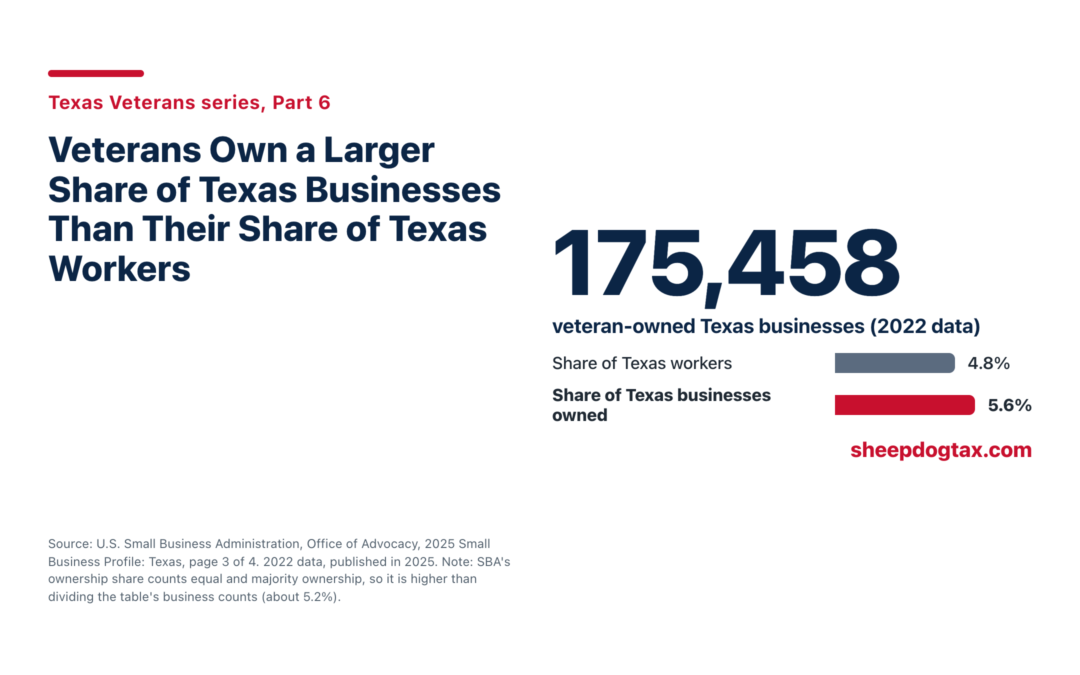
The U.S. Small Business Administration counts 175,458 veteran-owned businesses in Texas, using 2022 data published in its 2025 Texas profile. Veterans made up 4.8% of Texas workers and owned 5.6% of Texas businesses.
Texas veterans do not only work in the Texas economy. A good number of them own a piece of it. In the federal government’s latest small business profile for the state, veterans own a larger share of Texas businesses than their share of the Texas workforce.
This is Part 6 of the Texas Veterans series. Part 1 counted veterans, Part 2 followed VA dollars statewide, Part 3 looked at the military retirees who use Texas bases, Part 4 measured the installations’ economic footprint, and Part 5 compared Bell County with Dallas County. This part turns from benefits to business.
Where the count comes from, and when
The source is the U.S. Small Business Administration’s Office of Advocacy, which publishes a Small Business Profile for every state. Page 3 of the 2025 Texas profile has two panels this article uses: “Business count by owner demographic group” and “Business ownership share by demographic group.” (Source: SBA Office of Advocacy, 2025 Small Business Profile: Texas, page 3 of 4)
One date matters more than any other here. The profile was published in 2025, but its business counts are 2022 data. SBA lists three Census Bureau sources for the panel: the American Community Survey 2022 5-year estimates, the Annual Business Survey 2022 and Nonemployer Statistics by Demographics 2022. So 175,458 is a count for 2022, not a 2025 count of businesses.
175,458 veteran-owned businesses
SBA counts 175,458 veteran-owned businesses in Texas. For comparison, the same table counts 3,209,634 Texas businesses that are not veteran-owned. (Source: SBA, 2025 Texas profile, page 3, “Business count by owner demographic group”)
Most of those veteran-owned businesses are small in the plainest sense: 152,000 have no employees, and 23,458 have employees. The no-employee count is rounded in SBA’s table; the employer count is exact.
A larger share of businesses than of workers
SBA’s second panel compares veterans’ share of Texas workers with their share of Texas businesses owned. Veterans made up 4.8% of Texas workers and owned 5.6% of Texas businesses. (Source: SBA, 2025 Texas profile, page 3, “Business ownership share by demographic group”)
Both percentages are SBA’s published figures. They are not recalculated here, and one detail about them matters:
Note: SBA’s ownership share counts equal and majority ownership, so it is higher than dividing the table’s business counts (about 5.2%).
In other words, if you divide 175,458 by all 3,385,092 businesses in SBA’s count table, you get about 5.2%, not 5.6%. SBA says its ownership shares include businesses that veterans own equally with others, which is why its published share is higher. Either way, the veteran share of businesses owned is above the 4.8% veteran share of workers.
These are two different measures, a share of workers and a share of businesses owned, which SBA presents side by side. The data say nothing about why veterans own the share they do, and this article does not offer a reason.

Employers and businesses without employees
Of the 175,458 veteran-owned businesses, 23,458 have employees. SBA puts that at 13.4% of the veteran-owned total. The other 152,000, or 86.6%, have no employees.

Compared with businesses that are not veteran-owned
The same table lets the two groups be compared on one measure. 13.4% of veteran-owned Texas businesses have employees (23,458 of 175,458), compared with 12.7% of Texas businesses that are not veteran-owned (408,634 of 3,209,634). Put the other way, 86.6% of veteran-owned businesses and 87.3% of other businesses have no employees. The percentages are SBA’s. (Source: SBA, 2025 Texas profile, page 3)
The gap is small, and the profile does not say what drives it. On this one measure, a slightly larger share of veteran-owned businesses are employers.

What these numbers do and do not say
They are 2022 counts. The profile is SBA’s 2025 edition, but the business data are from 2022.
Some counts are rounded. The counts of businesses without employees (152,000 veteran-owned and 2,801,000 not veteran-owned) are rounded in SBA’s table. The employer counts are exact.
The shares are SBA’s. The 4.8% and 5.6% are as published. SBA does not say which of its three sources feeds which share, so this article does not compute its own ownership share, apart from the about-5.2% check above.
They are not a population count. No veteran population totals from VA, the Bureau of Labor Statistics or the Census Bureau’s veteran tables are used, and there are no dollar figures. This part of the series stays inside one data system: SBA’s profile.
They do not explain why. The profile counts businesses and shares. It does not show why veterans own the share of Texas businesses they do.
A Texas program for qualifying new veteran-owned businesses
Texas also has a program aimed at new veteran-owned businesses. Everything in this section is attributed to the agency or legislative record that published it, and none of it is a statement that any business qualifies.
What the Comptroller says. According to the Texas Comptroller of Public Accounts, a qualifying new veteran-owned business is not subject to Texas franchise tax and is not required to file a Public Information Report or Ownership Information report for its initial five-year period. The Comptroller lists three conditions. The entity must be formed or organized in Texas on or after January 1, 2016, and before January 1, 2020, or on or after January 1, 2022. It must be 100 percent owned by natural persons who are each honorably discharged veterans. And each owner must have a Letter of Verification of Veteran’s Honorable Discharge from the Texas Veterans Commission. (Source: Texas Comptroller, New Veteran-Owned Businesses and Texas Franchise Tax)
What the Secretary of State says. The Texas Secretary of State describes related filing-fee relief for new veteran-owned businesses formed on or after January 1, 2022. (Source: Texas Secretary of State, Business Information for Veterans)
What changed in 2025. The Texas Veterans Commission reported on December 17, 2025, that the exemption from franchise tax and certain filing fees for eligible new veteran-owned businesses was made permanent in the last legislative session. In the legislative record, House Bill 346 of the 89th Legislature removed the scheduled repeal of the exemption. Its enrolled text repeals Section 9 of Chapter 859 (S.B. 938), Acts of the 87th Legislature, Regular Session, 2021, which had provided for the repeal of Tax Code Section 171.0005 and related sections as of January 1, 2026. The official bill history shows HB 346 was signed by the Governor on June 12, 2025, and took effect September 1, 2025. (Sources: Texas Veterans Commission, Dec. 17, 2025; HB 346 (89R), enrolled text; HB 346 bill history)
What is not here. No official public count of how many businesses have used the exemption turned up in the published sources, so this article does not give or estimate one. Eligibility depends on individual facts. The Comptroller’s page and the Texas Veterans Commission are the official places to read the rules.
Educational only. Not tax advice.
Every figure in one table
The table below has every SBA figure this article uses, and the download has every row of the source data.

What comes next
Part 7 looks at the Texas veteran workforce: how many veterans are employed in Texas and how many are in the labor force.
Thank you to every veteran who calls Texas home.
Methods and caveats
- Source. U.S. Small Business Administration, Office of Advocacy, 2025 Small Business Profile: Texas (PDF), page 3 of 4: “Business count by owner demographic group or location type” and “Business ownership share by demographic group.” https://advocacy.sba.gov/wp-content/uploads/2025/06/Texas_2025-State-Profile.pdf. Retrieved Nov. 22, 2026.
- Vintage. 2022 data, published in 2025. SBA lists the American Community Survey 2022 5-year estimates, the Annual Business Survey 2022 and Nonemployer Statistics by Demographics 2022 as the panel’s original sources, without saying which source feeds which share. Never read 175,458 as a 2025 count.
- Rounding. Counts without employees (152,000; 2,801,000) are rounded in the source. Counts with employees (23,458; 408,634) are exact. Percentages are as published by SBA.
- Ownership shares. The 4.8% (share of workers) and 5.6% (share of businesses owned) are SBA’s published figures. SBA’s ownership share counts equal and majority ownership, so it is higher than dividing the table’s business counts (about 5.2%, which is 175,458 divided by 3,385,092).
- One system. No VA, BLS or ACS veteran population totals are used and no dollar figures appear, so no data systems are mixed.
- No causes. The data do not explain why veterans own the share of businesses they do or why the employer shares differ.
- Tax material. The franchise tax section reports what the Texas Comptroller, the Texas Secretary of State, the Texas Veterans Commission and the enrolled text and bill history of HB 346 (89R) say. It is general information, not a determination that any business qualifies. No count of businesses using the exemption was found in the published sources.
Frequently asked questions
Is 175,458 a 2025 count?
No. It comes from SBA’s 2025 Texas profile, but the business data are from 2022.
Why does the article say 5.6% and also about 5.2%?
5.6% is SBA’s published share of Texas businesses owned by veterans, and SBA says its ownership shares count equal and majority ownership. Dividing the table’s veteran-owned count by all businesses in the table (175,458 of 3,385,092) gives about 5.2%. Both are above the 4.8% veteran share of Texas workers.
Does this show veterans are better at business?
No. SBA presents a share of workers and a share of businesses owned, which are different measures. The profile does not explain the difference, and this article makes no claim about why.
What counts as a business “with employees”?
SBA’s table splits businesses into those with employees and those without. 23,458 veteran-owned businesses have employees; 152,000, a rounded figure, do not.
How many veteran-owned businesses use the franchise tax exemption?
No official public count was found in the published sources, so none is given here.
Does my business qualify for the franchise tax exemption?
This article cannot answer that. It reports what the Comptroller, the Secretary of State, the Texas Veterans Commission and the legislature have published; eligibility depends on individual facts.
Can I check the numbers?
Yes. Each interactive chart has a “Download data (CSV)” button, and SBA’s profile is linked under Sources.
Sources
- U.S. Small Business Administration, Office of Advocacy, 2025 Small Business Profile: Texas. https://advocacy.sba.gov/wp-content/uploads/2025/06/Texas_2025-State-Profile.pdf. Retrieved Nov. 22, 2026.
- U.S. Small Business Administration, Office of Advocacy, 2025 Small Business Profiles for the States, Territories, and Nation. https://advocacy.sba.gov/2025/06/30/2025-small-business-profiles-for-the-states-territories-and-nation/. Retrieved Nov. 22, 2026.
- Texas Comptroller of Public Accounts, New Veteran-Owned Businesses and Texas Franchise Tax. https://comptroller.texas.gov/taxes/franchise/veteran-business.php. Retrieved Nov. 22, 2026.
- Texas Secretary of State, Business Information for Veterans. https://www.sos.state.tx.us/corp/veterans.shtml. Retrieved Nov. 22, 2026.
- Texas Veterans Commission, Tax, fee exemptions for new veteran owned businesses made permanent (Dec. 17, 2025). https://tvc.texas.gov/news/tax-fee-exemptions-for-new-veteran-owned-businesses-made-permanent/. Retrieved Nov. 22, 2026.
- Texas Legislature, H.B. 346 (89R), enrolled text. https://capitol.texas.gov/tlodocs/89R/billtext/html/HB00346F.HTM. Retrieved Nov. 22, 2026.
- Texas Legislature Online, H.B. 346 (89R) bill history. https://capitol.texas.gov/BillLookup/History.aspx?LegSess=89R&Bill=HB346. Retrieved Nov. 22, 2026.
Educational only. Not tax advice.
General information, not tax advice. Your situation may differ.