
First published October 7, 2026.
Prepared and research checked October 6, 2026. Editorial series date: October 7, 2026. The series date identifies sequence and does not claim earlier publication.
The short version
Discovery is the starting point for theft-loss timing, but a realistic reimbursement claim can defer the portion it covers. Review what was reasonably knowable at each relevant year-end and document the defined recovery claim. Later repayments and filing deadlines require separate attention.
The money left your account in one year. You discovered the fraud in another. Your bank is still reviewing a claim, and investigators have not said whether anyone will recover funds. Which year’s tax return should show the loss?
There may be no single date that answers every part of that question. Federal theft-loss rules generally begin with discovery, but a reasonable prospect of reimbursement can delay the portion it covers. The task is to identify what the evidence supports at each relevant year-end.
You do not have to prove that recovery is impossible forever. You also cannot assume that money is deductible simply because it has not come back yet. This article explains the difference through a documented court decision and a separate fictional three-year example.
What the law actually says (primary authority first)
Keep three dates separate
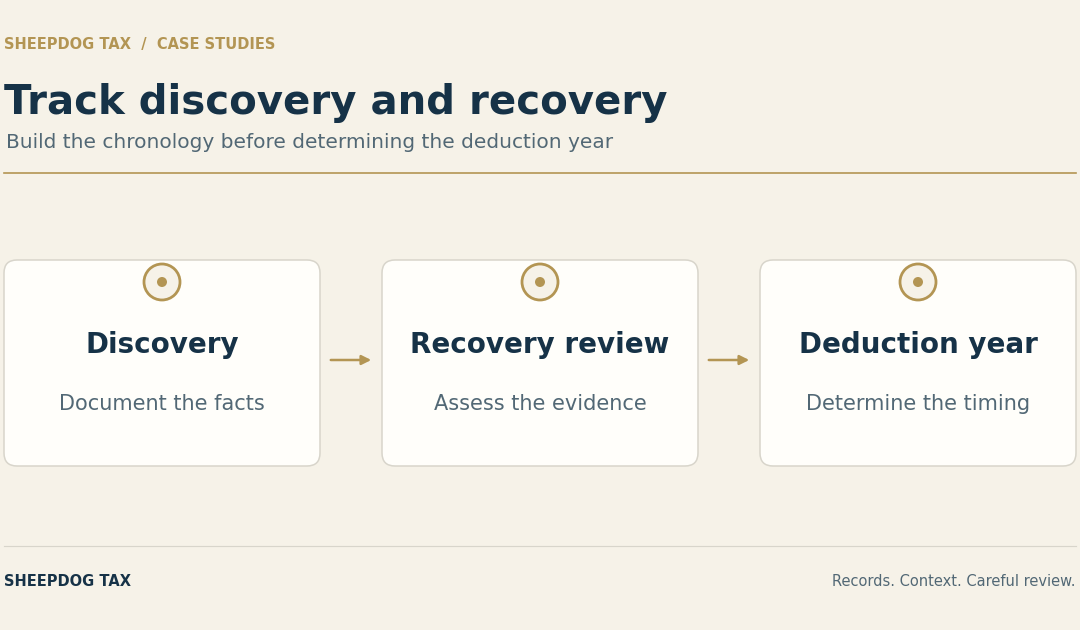
Build your timeline around when the property was taken, when you discovered the theft, and when the recovery position became sufficiently clear. Those events may fall in the same tax year, but they often do not.
Section 165(e) treats theft losses as sustained in the discovery year. Treasury Regulation section 1.165-1 adds that if a reimbursement claim offers a reasonable prospect of recovery, the portion it covers is deferred until the outcome can be determined with reasonable certainty.12
This is a facts-and-circumstances inquiry. A claim number, an open police investigation, or a pending lawsuit does not supply an automatic yes or no. The relevant questions include what the claim actually covers, its legal and factual support, and whether there is a realistic source of payment.
Timing also comes after eligibility. A loss must first fit the applicable tax rules, including proof of theft and the relevant business, investment, or personal-loss category. A later year does not cure a loss that fails those requirements. The general scam-loss guide explains that starting point.
What the court actually decided in Adkins
In Adkins v. United States, decided May 29, 2020, the Federal Circuit reviewed a 2004 theft-loss claim arising from fraudulent brokerage activity. The lower court had rejected the claim based on uncertainty about recovery and additional avenues the taxpayers might have pursued.3
The appellate court rejected treating uncertainty itself as disqualifying. It also rejected a requirement to exhaust every conceivable recovery route regardless of cost or likelihood of success. The record included stalled arbitration, impediments to obtaining evidence, criminal proceedings, and serious obstacles to collecting from the wrongdoers.
On that record, the court found no reasonable prospect of recovery in 2004. It reversed and remanded for calculation of the refunds implicated by the 2004 loss claim. It did not decide the taxpayers’ alternative Ponzi-safe-harbor argument.
The decision was fact-specific. It did not declare that pending claims can always be ignored or that every uncollected loss is immediately deductible. Governing court authority and the evidence in the reader’s own case still matter.
For a practical review, ask your adviser to explain both the claim’s merits and its likely collectibility. A strong legal argument against someone with no reachable assets can present a different recovery picture from a documented reimbursement claim against a solvent institution. The file should explain the difference rather than merely list the proceedings.
How it works in practice
A fictional timeline shows partial deferral
Illustration only. This example is fictional, uses the ordinary section 165 rules, and assumes no Ponzi-safe-harbor election. It is not a client result or a refund estimate.
Assume an individual discovers a fully substantiated $200,000 investment theft in 2023. No part has been deducted before. The amount already reflects the taxpayer’s basis and all money previously returned. All other requirements for a profit-seeking theft deduction are satisfied.
At December 31, 2023, the only realistic reimbursement avenue is a particular bank claim legally capped at $60,000. Assume that entire claim has a reasonable prospect of recovery and that no other portion has such a prospect.
2023: Separate the two portions. The currently sustained portion is $140,000. The remaining $60,000 is deferred while the bank claim remains realistically recoverable. The taxpayer has not treated the open claim as a reason to postpone the entire $200,000.
2024: The claim is resolved. Assume the bank settles for $25,000, pays it in full, and the outcome for the balance is established with reasonable certainty. All other reasonable recovery prospects remain absent. The unpaid $35,000 of the deferred portion becomes an additional loss in 2024. In this simplified example, the $25,000 payment relates to the portion never deducted.2
2025: An unexpected recovery arrives. The taxpayer receives $10,000 in restitution attributable to part of the loss properly deducted earlier. That calls for a tax-benefit analysis in 2025, rather than automatically treating the earlier deduction as erroneous.4
The money reconciles as follows:
- Original investment theft: $200,000.
- Loss amounts deducted before the unexpected recovery: $140,000 plus $35,000, totaling $175,000.
- Actual recoveries: $25,000 from the bank plus $10,000 in restitution, totaling $35,000.
- Remaining economic loss after both recoveries: $165,000.
These are loss and recovery amounts, not dollars of tax saved. The ultimate return calculation depends on the taxpayer’s other facts and the rules for each year.
The $60,000 deferral rests on the example’s specific legal cap and recovery assumptions. It is not a suggestion to multiply a claim’s face amount by a personally estimated probability of winning. In a real case, define the portion subject to the claim and substantiate the recovery assessment. Overlapping claims against a bank, insurer, and wrongdoer must also be reconciled so the same dollars are not counted repeatedly.
The numbers
Fictional three-year example from the narrative above. These amounts are loss and recovery figures, not tax savings.
| Year or measure | Amount | Origin and tax question |
|---|---|---|
| 2023 original substantiated theft | $200,000 | Fictional starting loss assumption; section 165 |
| 2023 loss portion currently sustained | $140,000 | Illustration arithmetic: $200,000 minus the $60,000 claim-specific deferral; regulation 1.165-1(d)(2)-(3) |
| 2023 portion deferred | $60,000 | Fictional legal cap and recovery assumptions; regulation 1.165-1(d)(2)-(3) |
| 2024 bank payment | $25,000 | Fictional completed recovery from the undeducted portion; regulation 1.165-1(d)(2)-(3) |
| 2024 additional loss | $35,000 | Illustration arithmetic: $60,000 minus $25,000, with the stated certainty assumptions; regulation 1.165-1(d)(2)-(3) |
| 2025 unexpected restitution | $10,000 | Fictional later-recovery assumption; separate tax-benefit review under section 111 |
| Economic loss after both recoveries | $165,000 | Illustration arithmetic: $200,000 minus $25,000 minus $10,000; not a statement of tax saved |
What this means for you
Make a dated recovery file
A useful file captures what was reasonably knowable at the relevant year-end. Start with the following records, as applicable:
- Bank recall or reimbursement requests, responses, denials, settlements, and payment records.
- Insurance terms, coverage correspondence, claim decisions, and identified limits.
- Counsel’s assessment of the claim, available defendants, costs, and collection obstacles.
- Receivership or bankruptcy reports identifying assets, competing claims, and possible distributions.
- Law-enforcement communications about recovered assets, forfeiture, restitution, or the absence of a known recovery source.
- Documents explaining a material change, such as a final settlement or newly discovered collectible assets.
For each source, note what portion of the loss it concerns. Keep the original document and its date. A summary saying “no recovery expected” is much more useful when accompanied by the letter, report, or analysis supporting it.
A bank’s message that it has opened an investigation establishes that a process exists. It may say little about whether the bank will reimburse the loss. Likewise, a large restitution order identifies an obligation; the practical ability to collect still needs attention. The recovery-prospect guide provides additional background.
Keep later developments in the timeline, too, while distinguishing them from information available at year-end. Later evidence may illuminate an earlier condition, but it should not casually replace the inquiry into what was reasonably known then. A file assembled today should identify the dates of its sources, not imply that every later discovery was available earlier.
An unexpected repayment has its own tax treatment
The regulations and section 111 address recoveries of previously deducted amounts. When a loss was properly deducted and reimbursement arrives later, the recovery is generally included in the receipt year’s income to the extent the earlier deduction produced a tax benefit.4 Section 111(c) also counts an increased carryover that has not expired before the recovery year begins as a tax benefit, even before it reduces tax paid.4
This means a later payment does not, by itself, require amending the original loss year. But the preparer must verify that the earlier deduction was proper and calculate the tax benefit under these rules. A taxpayer should not assume that every recovered dollar is taxable, or that a recovery is tax-free because it merely returns stolen money.
Give the preparer the original return, any amended return, the loss calculation, and documents identifying what the payment reimbursed. If prior loss deductions affected other years, include those records as well. Keep interest or other separately identified amounts visible rather than combining every payment under the heading “money back.”
The Ponzi safe harbor is a separate route
Certain qualifying fraudulent investment arrangements can use an optional IRS safe harbor with its own discovery-year and recovery rules. Revenue Procedure 2009-20, as modified by Revenue Procedure 2011-58, defines the eligible arrangement, investor, loss, triggering events, and election procedure.5
A victim’s police report is not automatically the qualifying criminal complaint against a scheme’s lead figure. Calling a fake platform a Ponzi scheme does not establish eligibility, either. The defined requirements must be checked before applying a safe-harbor percentage or choosing its deduction year.
Failure to meet the safe harbor does not necessarily end the ordinary theft-loss analysis. Keep the two approaches distinct and ask which one supports the proposed return position. The fictional timeline above uses only the general rules, so it should not be copied into a safe-harbor calculation.
Tax deadlines keep running while claims are pending
Waiting for an investigation to end can create a separate problem: a refund deadline may expire. Filing, payment, refund, insurance, and litigation deadlines should each be placed on the calendar. They do not all pause because another proceeding remains open.
Section 6511 generally requires a refund claim within three years after the return was filed or two years after the tax was paid, whichever is later. Additional rules limit how much tax can be recovered, and exceptions may apply. A professional needs the actual filing and payment history to determine the relevant deadline.6
A protective refund claim may be appropriate when entitlement depends on an unresolved event and the claim period could expire first. IRS Publication 556 explains that a valid protective claim identifies the contingency, the nature of the refund claim, and the affected years, among other requirements.7
This is a filing tool to consider with an adviser, not automatic permission to take a loss in a preferred year. It does not guarantee a refund or extend every other deadline. The proper year and any alternative positions still require analysis.
If you receive an IRS notice while recovery work continues, preserve the complete notice and obtain advice on its stated response deadline. Do not assume that sending the IRS a copy of your police report preserves all procedural rights.
Sheepdog Tax Resolution’s guide to IRS notices after a scam-loss deduction explains how to organize that separate response.
Use the correct year’s law and forms
A historical case can explain a timing principle without supplying today’s entire tax calculation. The Adkins litigation involved older tax years. Do not use historical carryback treatment to assume that a current deduction automatically generates a refund of earlier taxes.
Ordinary personal theft-loss restrictions continue in 2026, subject to statutory exceptions. Qualifying investment theft losses are excluded from miscellaneous itemized deductions under section 67(b)(3), even though miscellaneous deductions are currently disallowed by section 67(h). Such treatment does not make the deduction above-the-line. Rewritten section 68 may affect itemized deductions for certain high-income taxpayers beginning in 2026.8
The 2025 Form 4684 instructions available when this article was researched expressly discuss financial scams. Use the form, instructions, and law for the actual reporting year.9
Preserve recovery rights while getting the tax year reviewed
Do not abandon a viable claim simply to try to accelerate a deduction. Recovery decisions can have legal and financial consequences beyond tax. Coordinate them with counsel and the tax professional reviewing the loss.
For a Sheepdog Tax review, bring the transaction chronology, discovery evidence, recovery correspondence, returns already filed, and a list of upcoming deadlines. The documentation checklist can help you organize the file. Keep originals privately, redact unnecessary identifiers in preliminary copies, and use a verified secure sharing method. Never share passwords, private keys, or seed phrases. A focused review should explain which portion may be deductible, which portion may need to wait, and what evidence or protective filing deserves attention now.
This article provides general federal tax information, not individualized tax or legal advice. No deduction, refund, or recovery is guaranteed.
Related reading
Read the federal scam-loss framework.
Read how recovery prospects affect timing.
Read the theft-loss documentation checklist.
How Sheepdog Tax can help
I can review the affected tax years, transaction records, purpose evidence, and recovery correspondence with you. To arrange an initial discussion, contact Noah Green, CPA, CFE. Keep sensitive records private until a verified secure sharing method is agreed. The review depends on your facts and the applicable law; no deduction, refund, or recovery is guaranteed.
This article provides general federal tax information, not individualized tax or legal advice.
Sources (primary authority first, then secondary commentary)
- Internal Revenue Code section 165, especially subsections (a), (c), and (e).
- Treasury Regulation section 1.165-1(d)(2)-(3), including partial losses and recovery claims; section 1.165-8(a), theft-loss timing. These links reproduce the regulations at Cornell’s Legal Information Institute.
- Adkins v. United States, No. 19-1356, Federal Circuit, May 29, 2020, official opinion, especially pages 17-29. The judgment was reversed and remanded for refund calculations; the court did not reach the alternative safe-harbor argument.
- Internal Revenue Code section 111(a) and (c), including the treatment of unexpired carryovers; Treasury Regulation section 1.165-1(d)(2)(iii); IRS Publication 547, treatment of reimbursements received after a loss deduction.
- Revenue Procedure 2009-20, sections 4-6, as modified by Revenue Procedure 2011-58. Read the full eligibility and election conditions.
- Internal Revenue Code section 6511, particularly subsections (a) and (b), with applicable exceptions.
- IRS Publication 556, Protective claim for refund. The publication identifies a September 2013 revision; actual filing procedures, addresses, and deadlines require current verification.
- Public Law 119-21, sections 70109-70111; current section 67; current section 68. The discussion concerns current 2026 law, separate from the fictional 2023-2025 timeline.
- 2025 Instructions for Form 4684, Section B and “Losses From Financial Scams.” Research for this article was completed October 6, 2026; recheck developments before relying on it later.
Prepared by Noah Green, CPA, CFE.