
First published October 6, 2026.
Prepared and research checked October 6, 2026. Editorial series date: October 6, 2026. The series date identifies sequence and does not claim earlier publication.
The short version
A romantic introduction does not settle the tax treatment of every payment. Personal help and a later transaction intended to earn investment returns can require separate analysis. Preserve the messages and transfer records showing what you understood at the time, then review the other deduction requirements.
A person you met online asks for help with a family emergency. Months later, that same person offers to show you an investment platform. You send money for both reasons, then discover that the relationship and the platform were part of a fraud.
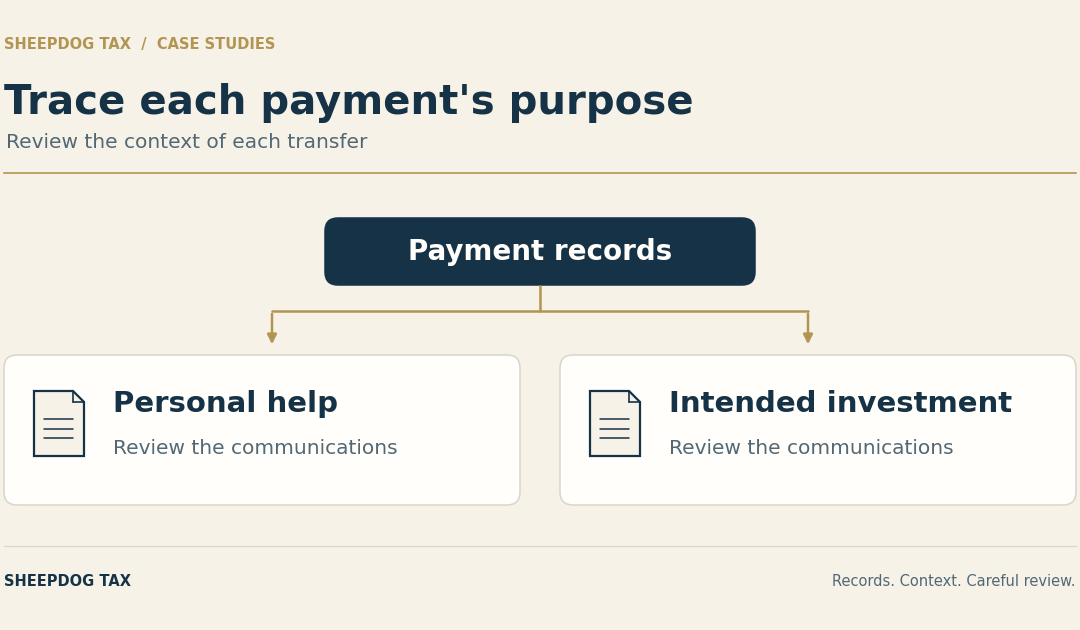
For federal tax purposes, those payments may require different answers. A romantic introduction does not automatically make every later transfer personal. An investment pitch does not automatically turn earlier gifts or emergency payments into investments.
The useful question is what each payment was intended to accomplish when you made it. Answering that honestly, with the original records, can help identify a possible deduction without rewriting what happened. It also avoids treating a label such as “romance scam” as the entire tax analysis.
This article explains the distinction through published IRS guidance and a separate fictional example. It focuses on individual federal income tax. No example is a promise that a particular loss will qualify.
What the law actually says (primary authority first)
The law distinguishes the purpose of the transaction
Internal Revenue Code section 165 separates an individual’s business losses, losses from transactions entered into for profit, and personal casualty or theft losses. Investment-related theft commonly raises the second category, section 165(c)(2).1
Consider two questions: What did you believe the recipient would do with the money? What financial result did you expect for yourself? Helping someone pay a supposed medical bill can have a personal purpose. Sending capital to a purported trading account to earn returns can have a profit-seeking purpose. Both payments can involve serious deception.
The distinction can feel uncomfortable when the same person manipulated your trust throughout. Tax classification is not a judgment about whether you deserve help or whether the harm was real. It addresses which statutory rules apply to the property and transaction.
It also means the source account does not answer every question. A payment withdrawn from a long-standing investment account can still be made for personal reasons. Trace both where the money came from and why you sent it to the next destination. The guide to transactions entered into for profit explains the broader framework.
The IRS specifically addresses a romantic introduction to investing
IRS Chief Counsel Advice 202511015, released in March 2025, discusses several assumed scam scenarios. In its Taxpayer 4 example, a victim sends money for an online partner’s supposed relative’s medical needs. The memorandum treats that payment as personal because it lacks a profit motive.2
Footnote 16 makes an important distinction: a romantic relationship may instead lead the victim into a fraudulent investment scheme. For that variation, the memorandum directs readers to its investment-scam analysis for Taxpayer 2. A reader who stops at the heading “Romance Scam” can therefore miss a material part of the guidance.
These are agency scenarios concerning 2024, not named clients or a Tax Court decision. The advice is nonprecedential, and its conclusions depend on assumed facts, including qualifying theft and the absence of reasonable recovery prospects. The footnote supplies no automatic deduction.23
For a real file, the practical lesson is to preserve the full sequence. The relationship can explain how trust developed; the investment communications can explain the purpose of a later transfer. Both belong in the record. Leaving out the relationship is unnecessary and can make the chronology harder to understand.
How it works in practice
A fictional example separates two payments
Illustration only. This is a fictional 2025 scenario, not a Sheepdog Tax client, an actual IRS determination, or a refund estimate.
A taxpayer develops an online relationship. The other person claims to need $12,000 for emergency medical help. The taxpayer sends it expecting neither repayment nor investment returns.
Later, the same person introduces a supposed trading platform. Its messages describe how deposited capital will earn returns, how the taxpayer can monitor a separate account, and how withdrawals will work. The taxpayer transfers another $80,000 specifically to invest and earn those returns.
The platform and the emergency were fraudulent. Assume the taxpayer discovers the theft in 2025, has records establishing theft under applicable state law, receives no payouts or reimbursements, and has no reasonable prospect of recovery at year-end. Also assume there are no personal casualty gains or qualifying disaster circumstances.
Under those deliberately simplified facts:
- The $12,000 was sent for a personal purpose. The assumed facts do not support an ordinary investment-theft deduction for that payment.
- The $80,000 presents a separate potential profit-seeking theft loss. Its treatment requires review of the investment purpose and the other deduction requirements.
- Adding the transfers produces $92,000 of money stolen. That arithmetic alone does not establish a $92,000 deduction.
The difference is supported by the taxpayer’s expectations and records at the time. It is not produced by assigning a favorable name to the second payment after the loss.
Suppose the trading messages instead said the $80,000 was a gift to help the partner achieve a personal dream, with no financial return to the taxpayer. A later spreadsheet calling it an “investment” would not resolve that conflict. Conversely, affectionate messages do not erase a documented plan to invest money for the taxpayer’s own returns. These variations illustrate why the full conversation matters.
This transfer-by-transfer method is an organizational approach to applying the law. It is not a court-created allocation formula. Related payments may form one larger transaction, and mixed motives can make the legal analysis more difficult. A preparer should understand the arrangement before deciding whether separate treatment is supportable.
The numbers
Fictional 2025 payment example from the narrative above. No row establishes an allowed deduction.
| Payment | Amount | Assumed purpose and source of analysis |
|---|---|---|
| Emergency medical help | $12,000 | Fictional personal-purpose assumption; section 165(c) distinguishes individual loss categories |
| Supposed trading investment | $80,000 | Fictional profit-purpose assumption, subject to the other requirements; CCA 202511015, footnote 16 illustrates the distinction without providing precedent |
| Total money transferred | $92,000 | Illustration arithmetic: $12,000 plus $80,000; the total is not automatically deductible under section 165 |
What this means for you
Build the evidence around what you understood then
Start with the original communications immediately before and after each transfer. Give the reviewer enough surrounding conversation to understand the payment, rather than isolated screenshots selected for a single word.
Useful materials may include:
- The initial request for money and your response, showing the stated purpose.
- Descriptions of projected returns, trading strategies, ownership, or profit sharing.
- Instructions identifying the platform, account, wallet, or recipient and connecting it to the proposed investment.
- Representations about when and how you could withdraw principal and earnings.
- Bank or exchange records showing the actual transfer and any money returned.
- Your contemporaneous questions about risk, returns, fees, or access to the funds.
These documents can be false as descriptions of the scammer’s business while remaining useful evidence of what you were told. A fabricated account agreement does not establish that a genuine account existed. It may help explain why you believed you were funding an investment.
A short chronology can make a large message archive manageable. For each payment, note the date, amount, destination, stated reason, expected return or repayment, and the location of the supporting records. Mark uncertainties openly. If you no longer have a message, say so rather than reconstructing its exact wording from memory.
Keep the originals intact. Make annotations on copies and preserve dates and sender information. Do not edit a personal request into an investment pitch, omit inconvenient passages, or ask someone to create a backdated agreement. An accurate file is more useful than a tidy story that the underlying records contradict.
The theft-loss documentation checklist provides a starting point for organizing the broader file.
Repayment promises and release fees need a closer look
Real histories are often less clean than the fictional example. A supposed loan may combine affection, promised repayment, and a share of future earnings. An apparent joint venture may leave unclear who owned the funds. Another payment may be described as a “tax” or “verification fee” needed to release earlier investments.
Those descriptions should trigger questions, not automatic conclusions. Was repayment genuinely expected? Was earning income the primary purpose? What agreement did the taxpayer believe existed? Did the later payment relate to recovering earlier capital, making a new investment, or meeting a separate personal need?
A promise to return money is not, by itself, a complete profit-motive analysis. Nor should a payment demanded to unlock funds be classified solely from the fraudster’s label. Its connection to the underlying transaction and the evidence of the taxpayer’s purpose need review. A loan can also raise issues outside a straightforward theft-loss analysis.
Group related transfers so the reviewer can see that connection, but retain the individual entries. This prevents a large series of payments from becoming one unexplained total. It also helps identify money that was returned, a separate legitimate purchase, or another event requiring different treatment.
A profit motive is only part of the deduction
Even a well-documented investment purpose leaves additional work. The current Form 4684 instructions discuss financial scams and require theft under applicable state law, the appropriate profit-seeking transaction, and the necessary recovery facts.4
A platform that fails or an investment that falls in value is not automatically a theft for tax purposes. The taking, criminal intent, applicable law, and supporting evidence need to be addressed. Likewise, a displayed account balance does not establish tax basis. The loss calculation must reconcile actual contributions, withdrawals, and reimbursements; previously reported fictitious income may require separate review.5
Timing is another question. Discovery generally starts the theft-loss inquiry. A reimbursement claim offering a reasonable prospect of recovery can defer the affected portion. An unresolved bank claim does not automatically disqualify the entire loss, and the fact that the bank has not yet paid does not automatically make it deductible.6
Finally, money taken from a retirement account may create a separate distribution issue. Establishing a possible theft deduction does not by itself remove income reported on Form 1099-R. Give your preparer the withdrawal documents along with the scam records so both questions can be considered.
Personal-loss restrictions continue in 2026
Some older explanations refer to restrictions on personal theft losses as ending after 2025. Congress removed that scheduled expiration. Ordinary personal scam losses did not become generally deductible in 2026. Statutory exceptions remain, including rules concerning personal casualty gains and qualifying disaster losses; the addition of state-declared-disaster provisions is not general relief for relationship scams.7
For a qualifying investment theft, section 67(b)(3) excludes the deduction from miscellaneous itemized deductions. The current disallowance of miscellaneous deductions, now in section 67(h), therefore does not itself eliminate that qualifying theft deduction. It remains generally an itemized deduction rather than an adjustment reducing adjusted gross income.8
The amount of tax saved still requires an actual return calculation. Beginning in 2026, rewritten section 68 can reduce itemized deductions for certain high-income taxpayers. Historical examples and older explanations should not be used to promise a dollar-for-dollar offset of every tax consequence.9
Bring the full story to the review
You do not need to decide in advance whether your experience should be called a romance scam or an investment scam. Start with a truthful chronology and the actual payments. Explain what you believed, what changed, what you expected to receive, and when you learned the money was gone.
For a Sheepdog Tax review, gather the affected tax years, original transfer records, relevant messages, prior returns, and recovery correspondence. Use the documentation checklist to identify gaps. Keep full originals privately and use a verified secure sharing method; never send account passwords, private keys, or seed phrases.
If the IRS has already requested support for a claimed deduction, Sheepdog Tax Resolution’s theft-loss audit guide provides related procedural reading.
The goal is a supportable answer for each part of the loss. That may mean different treatment for different payments, further evidence before filing, or a conclusion that a hoped-for deduction is unavailable. A careful review can explain those distinctions without minimizing what happened to you.
This article provides general federal tax information, not individualized tax or legal advice. No deduction, refund, or recovery is guaranteed.
Related reading
Read how investment purpose is evaluated.
Read the theft-loss documentation checklist.
How Sheepdog Tax can help
I can review the affected tax years, transaction records, purpose evidence, and recovery correspondence with you. To arrange an initial discussion, contact Noah Green, CPA, CFE. Keep sensitive records private until a verified secure sharing method is agreed. The review depends on your facts and the applicable law; no deduction, refund, or recovery is guaranteed.
This article provides general federal tax information, not individualized tax or legal advice.
Sources (primary authority first, then secondary commentary)
- Internal Revenue Code section 165, especially subsections (a), (b), and (c). Statutory text reproduced by Cornell’s Legal Information Institute.
- IRS Chief Counsel Advice 202511015, pages 7-8 and 10, especially footnote 16. Dated January 17 and released March 14, 2025; its examples address 2024.
- Internal Revenue Code section 6110(k)(3), limitation on using written determinations as precedent.
- 2025 Instructions for Form 4684, Section B, “Losses From Financial Scams.” Use the form and instructions for the year being reported.
- Revenue Ruling 2009-9, Issues 1 and 4; Treasury Regulation section 1.165-8(c), amount of theft loss. The ruling’s historical section 68 and net operating loss discussion should not be imported as current law.
- Treasury Regulation section 1.165-1(d)(2)-(3), including claim-specific recovery prospects and partial losses; section 165(e).
- Public Law 119-21, section 70109, effective for tax years beginning after December 31, 2025; current section 165(h)(5).
- Internal Revenue Code section 67(b)(3) and (h); Revenue Ruling 2009-9, Issue 2, for the itemized-deduction classification.
- Internal Revenue Code section 68, rewritten for tax years beginning after December 31, 2025.
Prepared by Noah Green, CPA, CFE.