
First published October 6, 2026.
Prepared and research checked October 6, 2026. Editorial series date: October 2, 2026. The series date identifies sequence and does not claim earlier publication.
The short version
A taxable retirement withdrawal and a possible theft deduction are separate questions. A public court decision about unauthorized withdrawals does not decide every scam victim’s return. Your withdrawal records, investment purpose, loss amount, and recovery evidence determine which questions need review.
Losing retirement savings to a scam can be followed by another shock: a tax form reporting the money as income. If you no longer have the money, how can you owe tax on it?
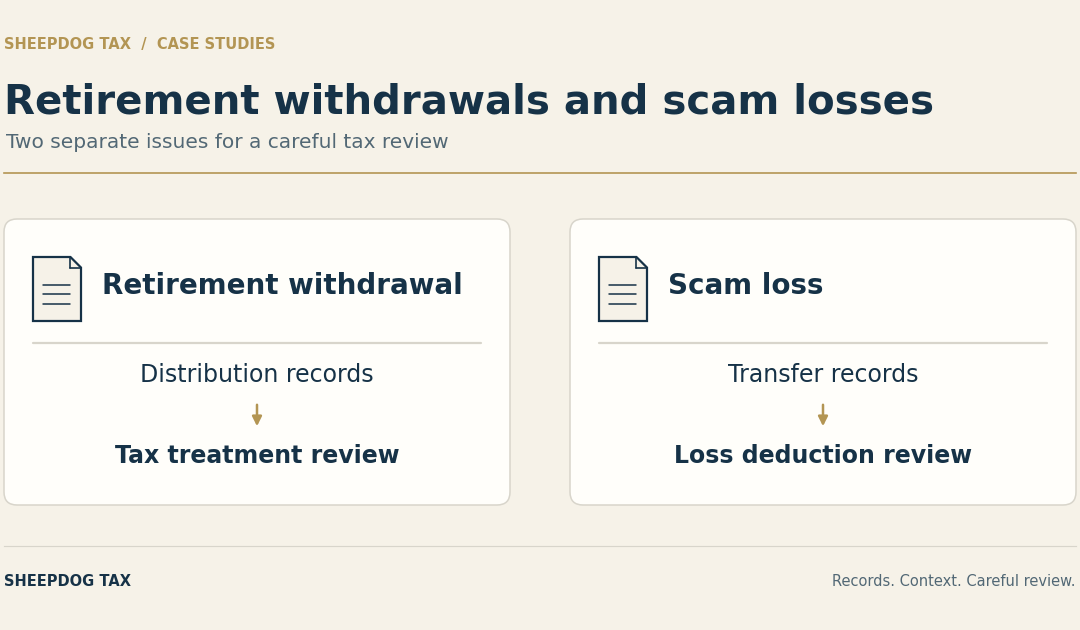
The answer usually requires two separate inquiries. First, was the retirement withdrawal taxable to you? Second, if it was, does the theft qualify for a deduction, and in which year? A favorable answer to the second question does not automatically undo the first.
This article explains that distinction through a public Tax Court case and a separate, fictional example. It focuses on federal income tax and traditional IRAs. Roth accounts, employer plans, and thefts occurring entirely inside a retirement account need their own analysis.
What the law actually says (primary authority first)
Start with how the money left the IRA
Traditional IRAs generally defer tax until money is distributed. Under Internal Revenue Code section 408(d), a distribution ordinarily becomes income to the person treated as its payee or distributee. After-tax contributions, qualifying rollovers, and other rules can change the taxable amount.1
Suppose you personally instruct your IRA custodian to withdraw money, receive it, and then transfer it to what you believe is an investment. Discovering that the investment was fraudulent does not automatically erase the IRA distribution. The withdrawal and the subsequent theft must each be analyzed.
That can sound like an unfair technicality after a devastating loss. It also identifies where the tax work needs to begin. Who requested the withdrawal? Who controlled the proceeds? What did you understand would happen to the money? Those answers can lead to different legal positions.
A scammer’s assurance that the transfer is a tax-free rollover does not make it one. The destination account and the transaction must actually satisfy the applicable retirement-account rules.1
What the Tax Court decided in Roberts
In Roberts v. Commissioner, 141 T.C. 569 (2013), $37,020 was withdrawn from Andrew Roberts’s IRAs during 2008. He learned about the withdrawals when Forms 1099-R arrived the following year. The withdrawal requests and check endorsements had been forged.2
The checks were payable to Roberts and went into a nominally joint bank account. Those facts could have made the transactions look like his withdrawals. But the court examined what actually happened. His then-wife controlled and used the proceeds for herself. Roberts had not authorized the transactions, received the money, or obtained an economic benefit from it. The withdrawals also did not discharge a legal obligation of his.
The Tax Court held that he was not the payee or distributee for those IRA withdrawals. They were therefore not included in his income for 2008, and he did not owe the section 72(t) early-distribution additional tax on them. Other tax issues remained in the case.
Roberts shows why a Form 1099-R should be investigated when it reports a withdrawal you did not authorize. It does not establish that every withdrawal induced by deception is excluded from income. Someone who personally directs a distribution and then sends the proceeds to a fraudster presents materially different facts.
For a disputed withdrawal, preserve the original instructions, signatures, account-access records, and destination-account information. A request to correct a tax form may be appropriate, but the underlying evidence matters even if the custodian declines to change it. The tax position needs support beyond the statement that the money was stolen.
An authorized withdrawal can still lead to a deductible theft
An IRS Chief Counsel memorandum released in March 2025 addresses an impersonator who persuaded a victim to authorize withdrawals and move investments into purported new investment accounts. In that scenario, the IRA distribution remained taxable. The subsequent theft qualified for a deduction because the transfer was undertaken to safeguard and reinvest the money for profit.3
The memorandum assumes facts that must be established in a real case: a theft under applicable state law and no reasonable prospect of recovery at year-end. Its examples concern 2024. It is nonprecedential advice, not a court judgment or an IRS approval of every scam-related deduction.
For an individual, section 165 distinguishes business losses, losses from transactions entered into for profit, and personal casualty or theft losses. The purpose of the relevant transaction matters. Taking money from an investment account does not, by itself, make every later payment an investment.4
The scam-loss deduction framework explains how those categories shape the review of money sent after a retirement withdrawal.
Messages promising investment returns, purported account agreements, and instructions about protecting investments can help establish what you were trying to do. A label such as “romance scam” or “crypto scam” cannot replace that factual review. A personal relationship may develop into a claimed investment opportunity, while a transfer from an IRA may instead fund a purely personal payment.3
An established profit-seeking theft loss may be an ordinary loss rather than a capital loss subject to the familiar $3,000 annual limitation. But an investment falling in value, even amid corporate fraud, does not automatically establish a theft of the investor’s property.5
How it works in practice
A fictional example follows the money
Illustration only. This is not a SheepdogTax client story, an actual IRS ruling, or a refund estimate.
Consider a single taxpayer, age 67, in tax year 2024. Before the scam, she has $100,000 of other income and $20,000 of otherwise allowable itemized deductions. Assume there are no other adjustments or interacting provisions in this simplified calculation.
Her timeline is as follows:
- She authorizes a $200,000 withdrawal from a traditional IRA containing no nondeductible contributions. She receives the entire amount without withholding.
- She transfers the $200,000 to a purported investment promising returns. In this example, all of it is stolen. There are no separate sales of other property to analyze.
- She discovers the theft during 2024. Assume there are no payouts, reimbursements, insurance proceeds, or reasonable recovery prospects at year-end.
- Assume legal and factual review establishes an allowable $200,000 profit-seeking theft deduction for 2024.
The last assumption is doing important work. The calculation below illustrates the effect of an allowed deduction; it does not establish eligibility for one.
The numbers
All dollar values in this table are fictional assumptions or arithmetic from the scenario above. The cited law supplies the framework, not these amounts.
| Simplified 2024 scenario | Income | Itemized deductions | Taxable income | Origin and authority |
|---|---|---|---|---|
| Without the withdrawal or theft | $100,000 | $20,000 | $80,000 | Fictional scenario or arithmetic; section 165 and recovery regulation |
| With the taxable withdrawal and no theft deduction | $300,000 | $20,000 | $280,000 | Fictional scenario or arithmetic; section 165 and recovery regulation |
| With the taxable withdrawal and allowed theft deduction | $300,000 | $220,000 | $80,000 | Fictional scenario or arithmetic; section 165 and recovery regulation |
The IRA distribution is included in income in both scam scenarios. In the final row, a separate deduction reduces taxable income. The taxpayer has still lost $200,000. A deduction of that amount does not return $200,000 to her.
This table does not calculate final tax. An itemized deduction generally does not reduce adjusted gross income, commonly called AGI. The distribution can therefore have other consequences tied to income, and state tax treatment may differ. The example deliberately leaves those effects out.6
Age matters, too. If the taxpayer were 55 and no statutory exception applied, the $200,000 taxable distribution could produce a $20,000 additional tax under section 72(t), even with the separate theft deduction. Scam victimization is not a general exception in the enacted statute reviewed for this article. Certain SIMPLE IRA distributions have a higher additional-tax rate.7
That additional tax is different from an accuracy-related penalty or a penalty for filing or paying late. Any penalty-relief position requires its own review. A theft deduction should never be presented as a promise that every associated charge disappears.
What this means for you
The year and amount need their own evidence
The theft-loss rules generally start with the year you discover the theft. However, a claim offering a reasonable prospect of recovery can postpone the portion of the loss it covers until the outcome can be determined with reasonable certainty.8
That requires a year-end assessment of the available facts. Bank reimbursement, insurance, litigation, restitution, and other recovery avenues may matter. A police report does not automatically settle the question. An open investigation alone does not establish either that recovery is likely or that it is hopeless.
The recovery-prospect guide explains the timing questions to bring to that assessment.
In the fictional example, discovery and deductibility both occur in 2024 because the assumptions say so. If the facts instead support a later deduction year, you cannot place the loss on the withdrawal year’s return simply to make the amounts offset. This timing problem can leave a tax bill due before any deduction becomes available.
If the IRS is already questioning a claimed loss, Sheepdog Tax Resolution’s guide to IRS notices after a scam-loss deduction addresses that separate response process.
The amount also needs reconciliation. Start with actual money contributed or transferred, actual payments received, reimbursements, and tax basis. A fraudulent website showing a $900,000 balance does not establish a $900,000 deductible loss. Fictional gains that were previously reported as taxable income require separate analysis.9
Keep withdrawal withholding separate from money sent to the scammer. For example, an IRA’s gross distribution and the amount actually deposited into a fraudulent platform may differ. A return should reflect the supported figures for each transaction.
A sufficiently large qualifying theft loss may also affect a net operating loss calculation. That requires additional work; an unused deduction does not automatically become an immediate refund.10
Current law still limits personal scam losses
Older articles may suggest that restrictions on personal theft losses ended after 2025. Congress removed that scheduled expiration in 2025 legislation. Personal losses generally remain restricted in 2026, subject to statutory exceptions, including qualifying disaster rules and rules involving personal casualty gains. The new state-declared-disaster provisions do not create a general deduction for personal scams.11
A qualifying profit-seeking theft follows a different provision, section 165(c)(2). Such theft losses are excluded from the category of miscellaneous itemized deductions. That distinction can preserve a deduction even though miscellaneous itemized deductions are disallowed.6
There is another reason to be cautious with older explanations. Beginning in 2026, section 68 imposes a new itemized-deduction reduction for certain high-income taxpayers. A same-year theft deduction may therefore produce a different result than a simplified 2024 example suggests. The actual year’s rules must be applied before estimating the benefit.12
Proposed relief also needs to be separated from enacted law. As of the October 6, 2026 research check, the latest official record reviewed, dated October 5, shows that H.R. 9500, the Tax Relief for Fraud Victims Act, had passed the House and been referred to Senate Finance. Proposed relief should not be treated as law. Its status should be checked again before relying on an article published later.13
A police report does not create a Ponzi safe harbor
The IRS offers an optional safe harbor for certain fraudulent investment arrangements. It has specific requirements for the investor, arrangement, criminal or procedural events, discovery year, and recovery treatment.14
Filing your own complaint with law enforcement does not automatically satisfy the requirement for a qualifying criminal complaint against a lead figure. Nor does calling a scam a Ponzi scheme establish eligibility.
Conversely, failing to qualify for the safe harbor does not necessarily prevent an ordinary theft-loss deduction. The general rules must still be considered. A criminal conviction is not a universal prerequisite for that analysis.5
Bring a timeline and the original records
If retirement money was involved, a useful first file should include:
- IRA statements, Forms 1099-R, withdrawal requests, authorization logs, and any correspondence disputing the distribution.
- Bank statements, wire confirmations, checks, cryptocurrency transaction hashes, and records identifying where each transfer went.
- Original messages and platform records showing the promised investment, returns, or supposed need to safeguard existing investments.
- A dated account of when you first suspected a problem, when you discovered the theft, and what you learned afterward.
- Bank, insurer, law-enforcement, attorney, or restitution correspondence bearing on recovery prospects, especially information available at each relevant year-end.
- A reconciliation separating money sent, money actually returned, displayed gains, withholding, and recovery expenses.
Keep original files where possible and use copies for annotations. Preserve full originals privately, redact unnecessary identifiers for preliminary review, and use a verified secure sharing method. Never send passwords, private keys, or seed phrases. If an IRS notice has arrived, include the full notice and its response deadline. Do not wait for a criminal investigation to finish before getting that deadline reviewed.
Form 4684 is often part of reporting a qualifying theft loss; its Section B addresses business and income-producing property. The correct tax-year instructions and the rest of the return still matter.15
For a consultation with SheepdogTax, start with the affected years, the withdrawal documents, and your transaction timeline. Those records allow a focused discussion of whether the distribution belongs in income, whether a theft deduction is supportable, and what additional evidence or filing work is needed. The outcome depends on the facts and the applicable law, so no deduction, refund, or agency response can be promised in advance.
This article provides general federal tax information. It is not individualized tax or legal advice.
Related reading
Read the federal scam-loss framework.
Read how recovery prospects affect timing.
Read records for a theft-loss review.
How Sheepdog Tax can help
I can review the affected tax years, transaction records, purpose evidence, and recovery correspondence with you. To arrange an initial discussion, contact Noah Green, CPA, CFE. Keep sensitive records private until a verified secure sharing method is agreed. The review depends on your facts and the applicable law; no deduction, refund, or recovery is guaranteed.
This article provides general federal tax information, not individualized tax or legal advice.
Sources (primary authority first, then secondary commentary)
- Internal Revenue Code section 408(d), especially paragraphs (1), (2), and (3); IRS Publication 590-B, traditional IRA distribution rules. Account type and basis must be checked.
- Roberts v. Commissioner, 141 T.C. 569 (2013), especially pages 576-582. This link reproduces the court’s opinion; the court-issued PDF was not obtained for this draft. The IRS also discusses the holding in CCA 202511015, page 5, footnote 4.
- IRS Chief Counsel Advice 202511015, dated January 17 and released March 14, 2025, especially pages 5-8 and footnote 16. Its 2024 scenarios assume provable theft and no reasonable recovery prospect. It may not be used or cited as precedent. Its references to a 2018-2025 personal-loss restriction predate the legislation in note 11.
- Internal Revenue Code section 165(a), (b), and (c), individual loss categories and general limits.
- Revenue Ruling 2009-9, Issues 1-2 and corresponding holdings. Read its historical discussion of other limitations with current statutes; the article does not adopt its older section 68 or net operating loss rules.
- Internal Revenue Code section 67(b)(3); Revenue Ruling 2009-9, Issue 2. A qualifying nonbusiness investment theft deduction is generally itemized; exclusion from miscellaneous itemized deductions does not make it an above-the-line deduction.
- Internal Revenue Code section 72(t), including exceptions in paragraph (2) and SIMPLE IRA rules in paragraph (6); IRS Publication 590-B, Early Distributions.
- Internal Revenue Code section 165(e); Treasury Regulation section 1.165-1(d)(2)-(3), including partial recovery claims and facts-and-circumstances analysis.
- Treasury Regulation section 1.165-8, especially paragraph (c); IRS Publication 547, Figuring a Loss. Separate actual tax basis from a platform’s displayed balance.
- Internal Revenue Code section 172(a), (b), and (d)(4)(C). Current rules generally give post-2020 NOLs no carryback, an indefinite carryforward, and an 80 percent taxable-income limit on later deductions, subject to exceptions and other loss vintages. The older three-year carryback and twenty-year carryforward described in Revenue Ruling 2009-9 are not a current general rule.
- Public Law 119-21, section 70109; current section 165(h)(5). The amendments apply to tax years beginning after December 31, 2025.
- Internal Revenue Code section 68, as rewritten for tax years beginning after December 31, 2025. It reduces deductions by 2/37 of a specified lesser amount involving the 37 percent bracket. A theft deduction is not subject to a blanket current-law exemption under the old version of this provision.
- Official House Calendar for October 5, 2026, H.R. 9500 entry; bill text referred to the Senate. The calendar records House passage September 15 and referral to Senate Finance September 16. Recheck legislative status before publication.
- Revenue Procedure 2009-20, sections 4-6, as modified by Revenue Procedure 2011-58. The optional safe harbor has requirements beyond a victim’s report to law enforcement.
- 2025 Instructions for Form 4684, Section B and Losses From Financial Scams. Use the form and instructions for the year actually being reported.
Prepared by Noah Green, CPA, CFE.