
First published October 6, 2026.
Prepared and research checked October 6, 2026. Editorial series date: October 5, 2026. The series date identifies sequence and does not claim earlier publication.
The short version
A fabricated account balance is evidence of what a platform claimed, not proof of your tax basis. Reconcile actual contributions, real payments received, and recoveries before calculating a possible deduction. A separate timing review may defer the portion covered by a viable recovery claim.
The platform showed $840,000. Your bank records show $300,000 sent out, $15,000 paid back, and a later $20,000 bank reimbursement. Which number belongs in the tax-loss discussion?
In the fictional cash-only example below, the unreimbursed economic loss is $265,000. Even that figure requires another review before determining how much is deductible for a particular year.
After a fraud, rebuilding the ledger can be painful. The balance on the screen may represent retirement plans or security you believed you had. Keeping that screenshot is important. The tax calculation, however, needs a documented account of what you invested, what came back, and what remains potentially recoverable. A fabricated balance cannot establish tax basis by itself. Section 165(b); Treasury Regulation section 1.165-8(c).
What the law actually says (primary authority first)
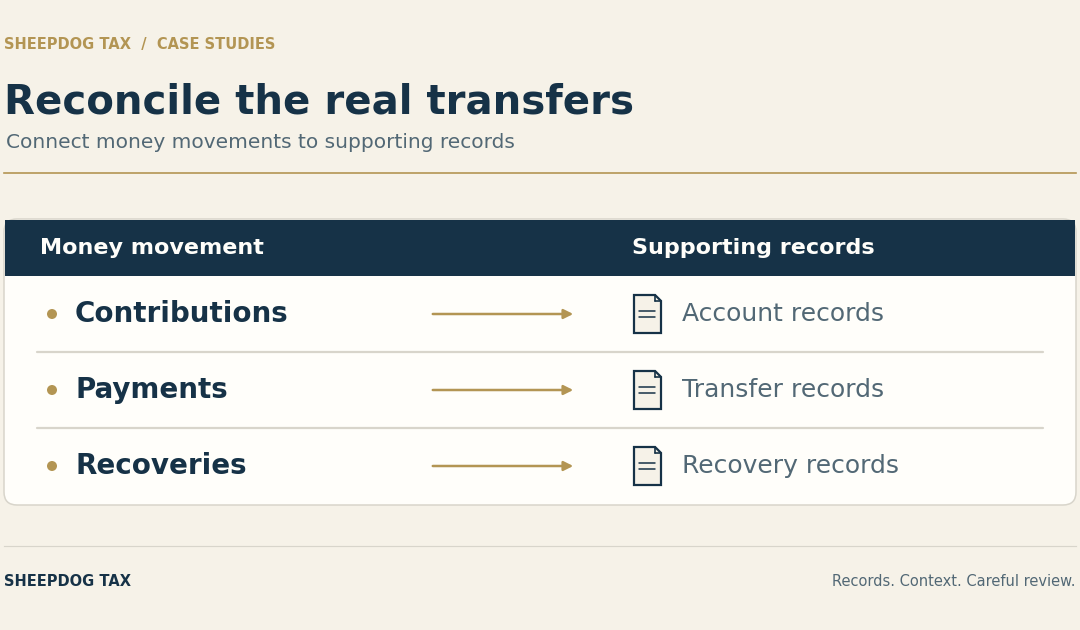
Keep four different numbers visible
Start with four separate lines in your working file:
- Displayed balance: what the platform claimed your account was worth.
- Actual contributions: cash or property you put into the arrangement, with its relevant tax basis.
- Actual returns and recoveries: what you received back from any source.
- Potential deduction for the year: the amount that survives the legal, measurement, and timing analysis.
This structure helps prevent a screenshot from becoming the starting balance in a tax calculation. It also prevents a different mistake: subtracting the same repayment once as a platform withdrawal and again as a recovery.
Section 165 distinguishes business losses, profit-seeking transactions, and personal losses. The arithmetic below assumes a qualifying investment theft. It cannot establish that classification, or prove theft, for an actual reader. Section 165(a)-(c).
How it works in practice
A fictional cash ledger from beginning to end
Illustration only, for tax year 2025. This is not a client story, tax-savings estimate, or refund calculation.
Assume an individual sent cash to a fraudulent investment, discovered the theft in 2025, and meets the requirements for a section 165(c)(2) loss. There are no real securities or digital-asset dispositions to analyze, no prior-year fictitious earnings included in income, and no additional deductible costs. All listed payouts and reimbursements have actually been received and retained.
The numbers
All dollar values in this table are fictional assumptions or arithmetic from the scenario above. The cited law supplies the framework, not these amounts.
| Ledger entry | Amount | Why it appears here | Origin and authority |
|---|---|---|---|
| First cash contribution | $40,000 | Verified money sent to the scheme | Fictional scenario or arithmetic; section 165 and recovery regulation |
| Second cash contribution | $160,000 | A separate verified contribution | Fictional scenario or arithmetic; section 165 and recovery regulation |
| Third cash contribution | $100,000 | A separate verified contribution | Fictional scenario or arithmetic; section 165 and recovery regulation |
| Total cash contributed | $300,000 | Sum of the three outgoing payments | Fictional scenario or arithmetic; section 165 and recovery regulation |
| Actual payouts previously received | ($15,000) | Real money returned, with no income or basis additions in this simplified example | Fictional scenario or arithmetic; section 165 and recovery regulation |
| Bank reimbursement received in 2025 | ($20,000) | A separate, completed recovery | Fictional scenario or arithmetic; section 165 and recovery regulation |
| Unreimbursed cash loss | $265,000 | $300,000 minus $15,000 minus $20,000 | Fictional scenario or arithmetic; section 165 and recovery regulation |
| Platform’s final fabricated display | $840,000 | Retained as evidence; excluded from this calculation | Fictional scenario or arithmetic; section 165 and recovery regulation |
The table does not subtract the display’s imaginary gains from $840,000. It builds the amount from substantiated transactions. That avoids having to accept any part of the platform’s fictional accounting as genuine.
Save the three outgoing confirmations, the statement showing the payout, and the bank’s reimbursement notice. Give each a reference that appears next to the matching ledger row. The total should be reproducible by another person without relying on your recollection of the platform balance.
If an examiner questions the reported amount, Sheepdog Tax Resolution’s guide to theft-loss deduction audits addresses the related response process.
Check what each incoming payment really represents
A fraudster may label a small payout “profit,” “interest,” or “a successful withdrawal.” The label alone does not resolve its tax treatment. Revenue Ruling 2009-9’s investment-fraud calculation takes withdrawals into account along with contributions and recoveries. Prior income reporting can add another layer. Revenue Ruling 2009-9, Issue 4.
In this example, the $15,000 genuinely reached the taxpayer and stayed outside the scheme. A withdrawal marked “completed” on the platform, with no corresponding receipt, would not fit that assumption. Conversely, an actual payout still belongs in the reconciliation even if the website later deletes its entry.
Check whether the taxpayer sent returned money back to the scheme. If the $15,000 came out and was later reinvested, both movements need rows. Do not quietly add a fourth contribution while retaining a total that already includes it. The reconciliation should show whether the same dollars traveled more than once.
Likewise, separate a temporary bank credit from a reimbursement the taxpayer actually retained. Record any later reversal. A ledger describing every provisional credit as a final recovery could understate the loss; a ledger omitting retained reimbursement could overstate it. Flag uncertainty rather than forcing a doubtful payment into a final total.
The current-year amount needs a recovery review
Assume first that there is no reasonable prospect of further recovery at the end of 2025. On the other facts already assumed, $265,000 is the candidate theft-loss amount before other applicable tax rules.
Now change one fact. Suppose a separate, legally supportable reimbursement claim is capped at $50,000 and has a reasonable prospect of recovery at year-end. No other portion is potentially recoverable. The simplified timing reconciliation becomes:
| Timing calculation | Amount | Origin and authority |
|---|---|---|
| Unreimbursed loss from the cash ledger | $265,000 | Fictional scenario or arithmetic; section 165 and recovery regulation |
| Portion subject to the defined recoverable claim | ($50,000) | Fictional scenario or arithmetic; section 165 and recovery regulation |
| Currently sustained portion under these assumptions | $215,000 | Fictional scenario or arithmetic; section 165 and recovery regulation |
| Portion deferred pending a sufficiently certain outcome | $50,000 | Fictional scenario or arithmetic; section 165 and recovery regulation |
The regulation postpones the portion covered by a claim with a reasonable prospect of recovery until the reimbursement outcome can be ascertained with reasonable certainty. It requires a factual assessment. Treasury Regulation section 1.165-1(d)(2)-(3).
The $50,000 in this illustration is an assumed claim-specific cap. It is not the result of multiplying the entire loss by a personal estimate of the chance of success. Nor does merely opening a bank investigation establish the conclusion. Preserve the claim terms, responses, and evidence supporting the year-end assessment.
Keep the earlier $20,000 reimbursement separate: it has already reduced the ledger. The new claim must not cover those same reimbursed dollars a second time. The guide to reasonable prospects of recovery explains this timing issue in more detail.
Previously reported fictitious income needs its own schedule
Now consider a separate variant. Assume $12,000 of fictitious earnings had been included in gross income on an earlier federal return and reinvested under facts fitting Revenue Ruling 2009-9. The ruling provides for qualifying previously included and reinvested income to increase the investment-theft-loss amount. Revenue Ruling 2009-9, Issue 4.
That requires checking the actual return, the income reported, and the reinvestment history. A tax form received from a platform does not by itself establish that the amount was included in gross income. A displayed gain that never entered a return is a different fact pattern.
Keep this $12,000 out of the main cash-only example. Use a separate schedule listing the reporting year, return line or supporting statement, amount, and reinvestment evidence. Ask the preparer to reconcile any amendment or other adjustment to the earlier income treatment with the proposed loss basis. The same item should not generate duplicate tax benefits through inconsistent treatments.
The useful question is precise: “Which previously reported amounts belong in this loss calculation, and why?” Starting with that question is safer than adding all claimed profits or assuming every earlier return should be amended.
Digital assets can add real transactions to the story
The example deliberately uses cash. If you purchased cryptocurrency at a real exchange, sold securities to raise funds, or transferred coins you already owned, more analysis may be needed. The acquisition cost, any actual disposition, and the property ultimately lost can involve different amounts and dates.
Keep genuine exchange and wallet records separate from trades displayed only on the fraudulent platform. Do not assume that every screen entry represents an actual asset purchase. Do not assume that sending digital assets makes their displayed dollar value equal to their tax basis, either. The statutory measurement starts with adjusted basis. Section 165(b).
A practical way to organize the evidence is to trace one contribution from its original account through each intermediate account to its destination. Record movements between your own accounts without automatically counting each movement as a new investment in the scheme. The crypto scam loss guide provides related background.
The Ponzi percentages are a separate method
You may encounter advice to claim 95% or 75% of a loss. Those percentages belong to an optional procedure for qualifying fraudulent investment arrangements. Eligibility depends on defined investor, arrangement, loss, discovery-year, and procedural requirements. They are not general percentages for every scam.
Under Revenue Procedure 2009-20, the applicable percentage is applied to the qualified investment, followed by specified recovery adjustments. Choosing 95% or 75% is tied to the procedure’s third-party-recovery rules, rather than a reader’s desired level of caution. Revenue Procedure 2009-20, sections 4-6.
The qualifying criminal and procedural events also matter. A victim’s police report is not automatically the criminal complaint contemplated by the procedure. Revenue Procedure 2011-58 modified the requirements and includes a limited route involving a deceased lead figure and government civil proceedings with additional conditions. Revenue Procedure 2011-58, section 4.
The $265,000 and $215,000 illustrations use ordinary section 165 analysis, without a safe-harbor election. A preparer should establish the available method before doing the percentage calculation. Failure to qualify for the safe harbor does not, by itself, settle whether an ordinary theft deduction is available.
What this means for you
Build a ledger someone else can check
Use six columns: transaction date; source and destination; amount out; amount actually returned; source document; tax-treatment question. Add one row per movement and preserve the full original records privately, outside the working spreadsheet. For preliminary review, redact unnecessary account identifiers from copies and use a verified secure upload method.
Before treating the total as ready for review, ask:
- Can every outgoing payment be traced to an original record?
- Are transfers between my own accounts counted only where appropriate?
- Have actual payouts, reimbursement, reversals, and reinvestment been reconciled?
- Are fabricated gains kept separate from substantiated basis?
- Have prior tax returns been checked for reported fictitious income?
- Does the recovery assessment identify the affected amount and tax year?
An unexplained difference is a reason to investigate. Put it on an exceptions list instead of entering an invented balancing figure. You do not need a perfect file before seeking help; clearly identifying the missing statement or unresolved transfer makes that help more focused. The SheepdogTax documentation checklist can support that first review.
A deduction amount is only one input into the return
The 2025 Form 4684 instructions address financial scams in Section B for business and income-producing property. Follow the form and instructions for the year actually being reported. Establishing the figure for that form does not calculate the final tax benefit. Form 4684 instructions.
Qualifying theft deductions are excluded from miscellaneous itemized deductions under section 67(b)(3). That does not make a nonbusiness theft deduction an above-the-line reduction of adjusted gross income. For 2026, the rewritten section 68 also requires attention where applicable; older descriptions of a blanket theft-loss exemption from that limitation should not be copied into a current calculation.
If a loss contributes to a net operating loss, section 172 supplies separate computation and use rules. An unused deduction is not automatically a cash refund.
The result of good reconciliation is a supported starting point: the right dollars, counted once, assigned to the appropriate analysis. SheepdogTax can review that ledger together with the investment-purpose evidence, theft documentation, prior reporting, and recovery record. The final filing position depends on the complete facts.
General federal tax information only. All monetary illustrations are fictional. No deduction, tax savings, refund, or recovery is promised.
Related reading
Read how recovery prospects affect timing.
Read the digital-asset scam-loss guide.
Read the theft-loss documentation checklist.
How Sheepdog Tax can help
I can review the affected tax years, transaction records, purpose evidence, and recovery correspondence with you. To arrange an initial discussion, contact Noah Green, CPA, CFE. Keep sensitive records private until a verified secure sharing method is agreed. The review depends on your facts and the applicable law; no deduction, refund, or recovery is guaranteed.
This article provides general federal tax information, not individualized tax or legal advice.
Sources (primary authority first, then secondary commentary)
- Internal Revenue Code section 165, especially subsections (a)-(c) and (e); Cornell reproduction.
- Treasury Regulation section 1.165-8(c), theft-loss measurement; Cornell reproduction.
- Revenue Ruling 2009-9, Issue 4, invested amounts, withdrawals, recoveries, and qualifying previously included fictitious income. Its older section 68 and net-operating-loss descriptions should not be treated as current rules.
- Treasury Regulation section 1.165-1(c)(4) and (d)(2)-(3), compensation and timing; Cornell reproduction.
- Revenue Procedure 2009-20, sections 4-6 and 8, optional safe harbor and general-rule alternative, read with the subsequent modification.
- Revenue Procedure 2011-58, section 4, revised qualifying-loss and discovery-year definitions.
- 2025 Instructions for Form 4684, Section B, financial scams, and Section C. The live instructions reviewed were the 2025 revision.
- Internal Revenue Code section 67(b)(3), exclusion from miscellaneous itemized deductions; Cornell reproduction.
- Internal Revenue Code section 68, rewritten limitation applicable for years beginning after December 31, 2025; Cornell reproduction.
- Internal Revenue Code section 172, net-operating-loss computation and use; Cornell reproduction.
Prepared by Noah Green, CPA, CFE.