
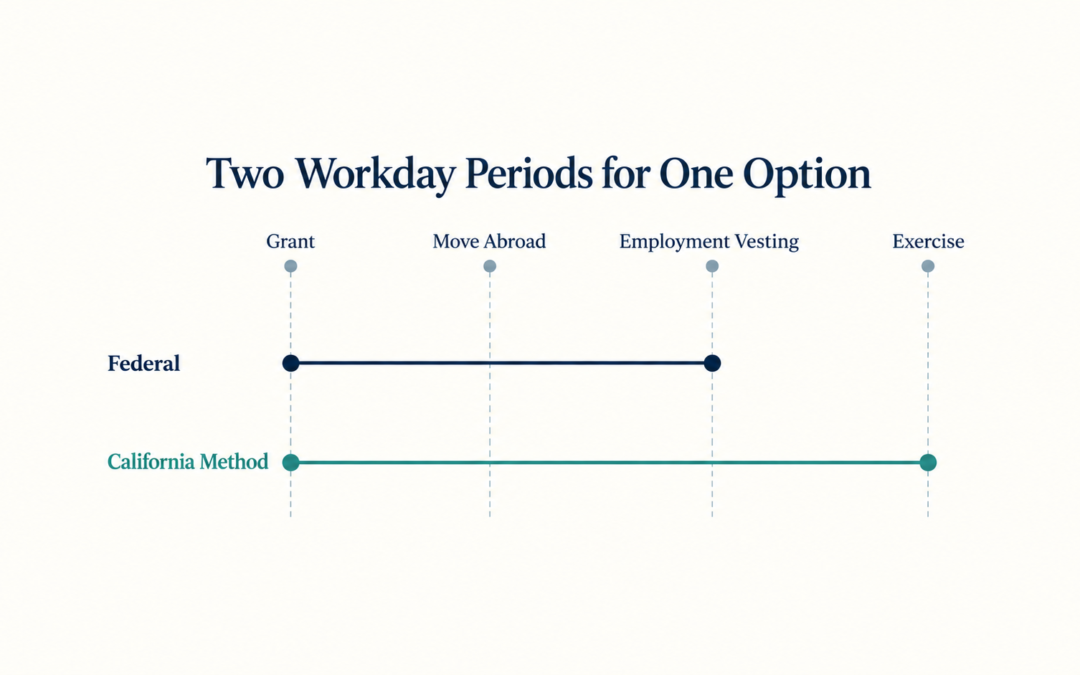
Illustration assumes continuous employment and fully vested shares at exercise; California's period ends earlier when employment terminates first.
The short version
You moved abroad, kept working for the same employer, and exercised a stock option after it vested. The federal calculation assigning compensation to U.S. work can use a different period from California’s calculation. Neither your current address nor the exercise date alone answers which income each government can tax.
This article concerns employee nonstatutory stock options, also called nonqualified options. It assumes the option had no readily ascertainable fair market value when granted and you receive fully vested shares when you exercise. Restricted stock units, incentive stock options, and early exercises involving forfeitable shares need their own analysis.
What the law actually says
Treasury Regulation 1.861-4(b)(2)(ii)(F) generally sources multi-year employee compensation using the services performed during the period to which it relates. For stock options, that period ordinarily runs from grant until all employment-related conditions for exercise are satisfied. In this context, that is employment vesting. The rule remains sensitive to the award’s facts and circumstances.
For the ordinary time-based calculation, divide U.S. workdays during that period by total workdays during the same period. Apply the percentage to the compensation. Later services ordinarily fall outside that federal window once the necessary employment conditions are complete.
That sourcing period is separate from when income is recognized. Under Treasury Regulation 1.83-7(a), an option without readily ascertainable fair market value at grant generally brings section 83 into play when exercised or otherwise disposed of. With fully vested shares acquired at exercise, the compensation is generally the shares’ value minus the exercise price.
For California, Revenue and Taxation Code section 17951 and 18 CCR 17951-5(b) anchor California taxation, during nonresidency, of compensation attributable to California services. FTB Publication 1004, section C describes one reasonable method: California workdays divided by total workdays from grant through exercise, stopping at employment termination if earlier.
The FTB publication is agency guidance, revised January 2015 and still linked from its current residency guidance. Its longer window can produce a different ratio. It does not say that time allocation is the only acceptable method in every case.
How it works in practice
Consider this hypothetical, with deliberately simplified workday counts. It is a teaching example, not a client result.
An employee receives one option grant on January 1, 2022. She works 200 days in California that year, then moves abroad on January 1, 2023. Assume she becomes a California nonresident, remains a U.S. citizen, and performs all subsequent work abroad. She works another 200 days before employment vesting on December 31, 2023, then 200 more before exercise on December 31, 2024. Employment continues throughout. No treaty changes the calculation.
She buys 1,000 shares for $20 each when they are worth $80 each. The compensation is $60,000: 1,000 multiplied by the $60 spread.
Applying the methods above:
- Federal sourcing uses 200 U.S. workdays out of 400 total workdays through employment vesting. The result is $30,000 U.S.-source compensation and $30,000 foreign-source compensation.
- California’s described method uses 200 California workdays out of 600 total workdays through exercise. The result is $20,000 California-source compensation.
The extra 200 foreign workdays enter California’s denominator but not the federal denominator. Both calculations begin with the same $60,000 compensation amount.
These are source amounts, not tax bills. Because she remains a U.S. citizen, the worldwide-income rule generally includes all $60,000 before any applicable relief. Calling $30,000 foreign-source does not make it automatically exempt. A nonresident alien has a different federal framework; living abroad alone does not establish that status.
Likewise, the California result assumes genuine nonresidency. A California resident generally faces tax on worldwide income. Establishing residence comes before choosing the nonresident source calculation.
The numbers in the official examples
The authorities themselves contain numerical examples. These concern different employees and should not be combined into one fact pattern.
| Official illustration | Numbers in the source | Source |
|---|---|---|
| Federal option compensation | 100 shares, $5 exercise price, $10 exercise value: $500 compensation | Treas. Reg. 1.861-4, Example 6 |
| Federal source allocation | 3.5 U.S. service years out of 5: 70%, or $350 U.S.-source compensation | Treas. Reg. 1.861-4, Example 6 |
| California source allocation | 700 California workdays plus 300 elsewhere: 70% California-source compensation | FTB Pub. 1004, section C, Example 3 |
The matching 70% results are incidental. They do not mean the governing periods match. These are official teaching examples, not statistics about employee tax outcomes.
What this means for you
Build the record around the award. Keep the grant agreement, amendments, employment vesting dates, termination date if applicable, and exercise confirmation. Reconstruct work locations across both possible periods, including U.S. trips after a foreign move. If parts of an award vest on different dates, do not assume one date answers every calculation.
Keep the later share sale separate. IRS Publication 525 explains that basis, the amount used to measure sale gain or loss, includes the exercise price plus compensation included in income. In the hypothetical, that is $20,000 plus $60,000, or $80,000. A later sale for $85,000, ignoring costs, produces $5,000 of gain, not another $65,000 of compensation.
For options granted on or after January 1, 2014, Publication 525 warns that Form 1099-B basis does not include the compensation amount. Reconcile payroll, exercise records, and the broker’s supplemental information before making the appropriate Form 8949 adjustment. The wage allocation percentage is not automatically the source rule for later capital gain: California section 17952 generally treats a nonresident’s investment-stock income differently, with business-related exceptions.
Finally, identify the foreign country and applicable treaty before drawing a cross-border conclusion. Treaty rules and foreign taxation require separate review. Federal treaty relief does not automatically carry over to California; the 2025 Schedule CA instructions preserve that distinction. None of these calculations, alone, establishes a reason to delay exercise.
Related reading
The State You Left May Still Own You explains why a state departure requires more than an address change. The Nomad Audit File provides context for organizing travel, work, and payroll evidence. Those records help establish the facts needed before applying an option’s sourcing rules.
How Sheepdog Tax can help
Email noah@sheepdogtax.com with your award type, the states and countries involved, and the next exercise or filing decision. I can discuss the records needed and whether a focused review fits your situation. Sheepdog Tax is a veteran-owned practice led by Noah Green, CPA, CFE.
This article provides general education, not an individualized tax conclusion. Award terms, residence, work history, and applicable law determine the result.
Sources
- Treasury Regulation 1.861-4, paragraphs (b)(2)(ii)(A), (E), (F), and (G), Example 6.
- Treasury Regulation 1.83-7(a), nonqualified stock options.
- California R&TC 17951 and 18 CCR 17951-5(b), nonresident compensation.
- California R&TC 17952, nonresident intangible income.
- FTB Publication 1004, revised January 2015, section C and summary table.
- IRS Publication 525 (2025), Nonstatutory Stock Options.
- IRS, U.S. citizens and resident aliens abroad, and Taxation of nonresident aliens.
- FTB, Part-year resident and nonresident, residency and equity compensation.
- IRS stock-compensation webinar transcript, instructional treaty discussion.
- 2025 Schedule CA (540NR) instructions, Part II, Tax treaty paragraphs.
Prepared by Noah Green, CPA, CFE.