
First published October 6, 2026.
Case status checked October 6, 2026. This page follows Vaia v. United States of America, No. 2:26-cv-00573, Southern District of Ohio.
The short version
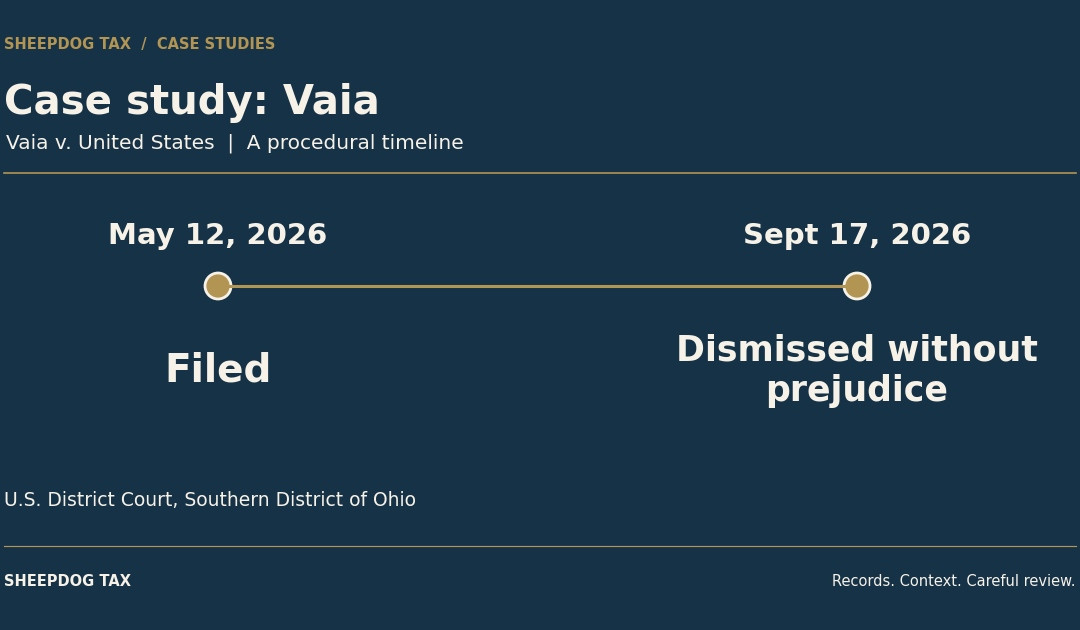
The existing Vaia lawsuit is closed. On September 17, 2026, the taxpayer filed a notice dismissing all claims without prejudice, meaning the notice did not resolve whether his claimed tax deduction was valid. It supplies no explanation for the dismissal and does not establish an IRS concession or a refund. This case study records the available filings and will be updated if a later filing changes that picture. Notice of dismissal, document 12, page 1.
What the law actually says
Federal Rule of Civil Procedure 41(a)(1)(A)(i) allows a plaintiff, subject to the rule’s qualifications, to end an action by notice before the opposing party serves an answer or a summary-judgment motion. Vaia’s notice invokes that provision and expressly says the dismissal is without prejudice. A dismissal in that form does not itself decide the tax issue. It also does not guarantee that another suit can be filed successfully: procedural requirements, time limits, and the rule’s treatment of repeated dismissals can still matter.
The underlying deduction question comes from Internal Revenue Code section 165. For individuals, section 165(c)(2) covers losses from transactions entered into for profit even when they are outside a trade or business. Section 165(a) requires an uncompensated loss, and subsection (b) measures it using adjusted tax basis. Those requirements make the purpose of the transaction and the supported amount important; a fraud label alone does not establish eligibility.
Our scam-loss deduction framework explains those questions. Vaia’s dismissal does not supply a new answer to them.
Timing is a separate issue. Section 165(e) addresses the discovery year for theft losses. Treasury Regulation section 1.165-1(d)(3) defers a portion subject to a reimbursement claim with a reasonable prospect of recovery until receipt or nonreceipt can be determined with reasonable certainty. That assessment depends on facts. Our recovery-prospect guide explains the records relevant to that inquiry. The tax-refund lawsuit’s dismissal is not a finding about recovery from the scammer.
How the case developed
The public PacerMonitor docket mirror lists a complaint for refund of federal income taxes filed May 12, 2026. The mirror identifies the plaintiff as Shane E. Vaia and the defendant as the United States of America. It is a third-party docket listing, rather than a substitute for reading the filings themselves.
Bloomberg Tax’s May 13 report described an Ohio taxpayer seeking a refund related to a claimed cryptocurrency scam loss and his 2024 taxes. This is reporting about a claim, not a court finding that theft occurred or a deduction was allowable. The original complaint and its exhibit have not yet been obtained for this case study, so their precise allegations and dollar calculations remain to be checked.
Patrick Camuso’s May 25 commentary identified Vaia as a potentially important crypto theft-loss dispute. That was commentary published before dismissal. It also gives dollar figures that differ from other materials reviewed. Until the underlying pleading is available, this page does not adopt an exact claimed loss or refund figure.
The docket mirror lists extensions of the government’s response deadline. Its July 20 entry states that the answer deadline was extended to September 25. Before that date, Vaia filed document 12 on September 17. The notice dismisses all claims in his complaint without prejudice, assigns costs to the plaintiff, and gives no reason. Its second page is a certificate of service dated September 17. Filed notice, pages 1 and 2.
Bloomberg Tax reported the withdrawal on September 18. The docket mirror lists the civil case as terminated September 17. The record reviewed for this page does not include a merits opinion or a document explaining an agreement over the deduction.
The numbers in the available record
These are procedural dates and document identifiers, not verified loss calculations. Each row identifies the record supporting it.
| Record item | Date or number | What it establishes | Source |
|---|---|---|---|
| Refund complaint | May 12, 2026; entry 1 | A refund action was filed | Public docket mirror, entry 1 |
| Order extending answer deadline | July 20, 2026; entry 11 | The listed answer deadline became September 25, 2026 | Public docket mirror, entry 11 |
| Voluntary-dismissal notice | September 17, 2026; document 12; 2 pages | All complaint claims were dismissed without prejudice | Filed notice, pages 1 and 2 |
| Case termination | September 17, 2026 | The mirror lists the civil case as terminated | Public docket mirror, termination entry |
What this means for you
A taxpayer’s request for a refund is different from a decision allowing one. The same distinction applies to withdrawing a case: document 12 contains no merits findings, refund computation, or explanation of the parties’ tax positions. The reason for withdrawal remains unknown from that document. It would be speculation to present it as either a deduction victory or a rejection of the deduction.
For your own claim, concentrate on records that can be examined independently: original transfers, investment messages, discovery chronology, and recovery correspondence. The theft-loss documentation checklist can help identify gaps. A later Vaia development may offer useful context, but it cannot replace support for your own transaction, amount, and deduction year.
If the IRS has already denied your deduction, Sheepdog Tax Resolution’s guide to denied theft-loss deduction options provides related procedural reading. Preserve your notice and have its deadlines reviewed. Waiting for another taxpayer’s case is not a response to your notice.
What this case study will track
The tracking scope includes further entries in this docket, any reopening, and a related new filing that can be verified as involving the same dispute. A new case will be identified by its own court and case number. Statements by the parties, media coverage, and practitioner commentary will be distinguished from the underlying court record.
Updates will state the date checked, identify the new document and relevant page, and explain whether the development changes procedure or addresses the deduction itself. If a public source is unavailable or an original filing cannot be obtained, that limitation will remain visible. Exact dollar amounts will be added only when their source and meaning can be reconciled.
Update history
October 6, 2026: Initial research baseline. Verified the September 17 dismissal notice and the public docket mirror’s termination entry. No explanation for dismissal or merits determination was found in the notice. The complaint and its exhibit remain outstanding.
Related reading
How Sheepdog Tax can help
I can review the tax years involved, the records supporting the loss, and the questions that need further investigation. Contact noah@sheepdogtax.com to discuss the intake process. Noah Green, CPA, CFE, provides tax and fraud-focused review through a veteran-owned practice. Eligibility and timing depend on the facts and applicable law.
Sources
- Vaia v. United States of America, No. 2:26-cv-00573, document 12, filed September 17, 2026, pages 1 and 2. Court filing publicly displayed by Bloomberg Law; checked October 6, 2026.
- Federal Rule of Civil Procedure 41(a)(1).
- Internal Revenue Code section 165(a), (b), (c)(2), and (e).
- Treasury Regulation section 1.165-1(d)(2) and (3).
- PacerMonitor public docket mirror, Vaia v. United States of America. Third-party procedural listing, checked October 6, 2026; displayed last update October 5, 2026.
- David Schultz, Bloomberg Tax, “Crypto Scam Victim Sues IRS to Deduct $800,000 in Losses,” May 13, 2026. Publicly available introduction; restricted full article was not accessed.
- David Schultz, Bloomberg Tax, “Victim of Crypto ‘Pig Butchering’ Scam Drops Tax Refund Lawsuit,” September 18, 2026.
- Patrick Camuso, CPA, “Digital Asset Digest: Weekly Round Up,” May 25, 2026. Secondary commentary; its figures are not adopted here.
Prepared by Noah Green, CPA, CFE.