
First published October 6, 2026.
Prepared and research checked October 6, 2026. Editorial series date: October 4, 2026. The series date identifies sequence and does not claim earlier publication.
The short version
A settlement can resolve the tax amounts in one case without supplying a legal rule for another taxpayer. Read the actual petition, decision, opinion, or IRS memorandum before relying on a headline. Compare the issue decided, the tax year, and the facts supported by your own records.
A headline about a scam victim prevailing against the IRS can feel like the first encouraging news you have read in months. It may also raise an urgent question: does that result mean your own loss is deductible?
The useful answer begins with the document behind the headline. A taxpayer’s petition, a settlement, a judge’s opinion, and an IRS legal memorandum do different jobs. Understanding those differences helps you identify an argument worth investigating without building your return around a conclusion the source never reached.
A settlement can bring substantial relief to the person involved. Its significance for another person depends on what was actually resolved, whether the reasoning is available, and how closely the relevant facts match. Here is a practical way to read the paperwork, illustrated by a real judicial opinion and a separate fictional settlement.
What the law actually says (primary authority first)
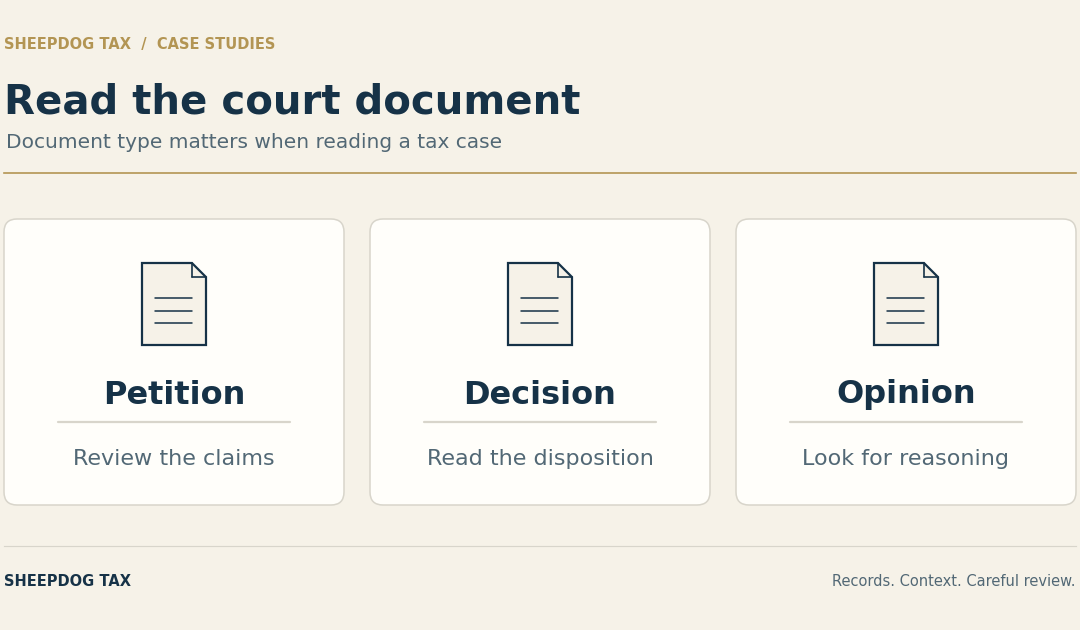
Identify the document before relying on the result
The word “case” can describe an entire dispute, from its opening allegations to its final disposition. A report about the case may discuss only one stage.
| Document | What it can tell you | What needs separate verification |
|---|---|---|
| Taxpayer’s petition | The taxpayer’s claims and requested relief | Whether the IRS agreed or the court found those claims true |
| Stipulated decision | The outcome the parties agreed to and the court entered | The legal reasoning, if the decision does not supply it |
| Judicial opinion | The court’s analysis and conclusions on identified issues | The opinion’s type, procedural status, and fit with your facts |
| IRS Chief Counsel Advice | The agency lawyers’ analysis of the stated facts | Its assumptions and its express nonprecedential status |
The Tax Court describes a stipulated decision as an agreed decision. Its guidance also distinguishes the explanatory opinion from the decision entered afterward. These distinctions are the starting point for reading a result, rather than treating every court-filed document as a ruling on the merits. Tax Court guidance on agreed decisions; guidance on opinions and decisions.
When someone provides only a screenshot, ask for the document title, court, docket number, date, and complete text. Those details are useful even if you ultimately need a professional to interpret the record. They make it possible to find the actual source instead of passing along a shortened description.
An opinion can answer a narrower question than the headline suggests
Consider Roberts v. Commissioner, 141 T.C. 569 (2013). Andrew Roberts’s then-wife caused unauthorized IRA withdrawals through forged requests and endorsements. The Tax Court examined whether $37,020 withdrawn during 2008 was taxable to Roberts. He had not authorized the transactions, received the proceeds, or obtained an economic benefit from them.
The court held that he was not the taxable payee or distributee for those withdrawals. The section 72(t) early-distribution additional tax therefore did not apply to those amounts. That was an income-inclusion ruling, rather than an award of a separate theft-loss deduction. Other issues had different outcomes, and the court expressly left possible later-year constructive-distribution questions unresolved. Roberts, 141 T.C. at 576-582 and note 19.
That precise description matters. “The money was stolen” does not identify which part of the tax calculation is disputed. The question may concern who received a distribution, whether a loss qualifies, how much basis was lost, or which year permits the deduction. Each question calls for different evidence.
The Sixth Circuit’s later Hubbard opinion recognizes the fraudulent-withdrawal distinction when discussing Roberts. Hubbard itself involved forfeiture, so it should not be retold as an investment-scam deduction case. Hubbard, pages 8-9.
How it works in practice
Compare the money movement and the legal issue
A useful case comparison begins with the acts that occurred. Did someone forge a withdrawal instruction? Did you instruct your custodian to distribute money because a fraudster deceived you? Did you receive the proceeds before transferring them elsewhere?
These questions are about the transaction record, not whether the deception was serious. An authorized withdrawal induced by fraud and an unauthorized withdrawal can both be devastating. They may raise different federal income-tax issues.
IRS Chief Counsel Advice 202511015 illustrates the authorized-transfer problem. In its assumed investment-scam scenario, a person moved money from IRA and non-IRA accounts to a fraudulent platform. The analysis treated the IRA distribution as taxable while recognizing a separate potential theft-loss deduction on the stated facts, including the absence of reasonable recovery prospects. CCA 202511015, pages 5-8.
For a reader, the practical consequence is to keep two files connected but distinct: the records showing how money left its original account, and the records showing what happened afterward. A document supporting one question may leave the other unanswered. A custodian’s distribution form, for example, does not by itself establish the later investment purpose or the amount ultimately recovered.
Read IRS advice with its assumptions attached
The 2025 advice is useful because it makes the IRS lawyers’ reasoning visible. It is not a court judgment awarding money to the people described. It also cannot be used or cited as precedent under section 6110(k)(3).
Treat an agency example as a comparison exercise. Write down its assumptions before applying its conclusion. Then mark which assumptions your records support, which differ, and which are still unknown. A conclusion about an investment transaction with established theft and no recovery prospect cannot simply be carried over to an unverified transfer with an unresolved reimbursement claim.
Also check the law for the year you are reporting. The advice’s discussion of personal-loss restrictions referred to 2018 through 2025. Subsequent legislation removed that sunset and added qualifying state-declared-disaster language for years beginning after 2025. Ordinary personal scam losses did not become generally deductible in 2026; statutory exceptions still require their own analysis. Public Law 119-21, section 70109.
This is why an accurate summary of an older source can still produce an inaccurate present-day answer. The source may be genuine, and its date may explain the mismatch.
What a fictional no-deficiency settlement establishes
Fictional illustration only. These figures do not describe a client, an actual examination, or a refund.
Assume an examiner proposes $48,000 in additional income tax and a $9,600 accuracy-related penalty. The IRS later issues a notice of deficiency, and the taxpayer timely petitions the Tax Court to dispute the adjustments. Both sides eventually sign an agreed decision stating no deficiency and no penalty for the year. The court enters it. No explanatory opinion accompanies the decision.
The result is important: those proposed amounts have been resolved in that case. But the face of the decision does not tell an outside reader which explanation led there.
| Possible explanation | Would the assumed decision establish it? |
|---|---|
| The IRS accepted the taxpayer’s theft-loss analysis | No; the assumed document gives no explanation |
| An income-reporting error was corrected | No; that remains a possible explanation |
| Newly supplied records changed the factual assessment | No; the decision does not identify the evidence |
| The parties resolved the dispute for another reason | No; the terms alone do not reveal the reason |
| The stated deficiency and penalty are zero for the specified year | Yes; that is the outcome the illustration expressly supplies |
Those possibilities are an explanation of the limits of this fictional document. They are not claims about what happened in any reported scam case.
Nor does the zero-deficiency language, standing alone, establish an overpayment or show that stolen funds were returned. The fictional $9,600 is an examination penalty, not the section 72(t) additional tax on early retirement distributions. Conflating those items can turn a favorable result into a much broader claim than the paperwork supports.
For another taxpayer, the useful next step is to look for available reasoning or underlying authority. If none is available, the settlement can remain relevant background without supplying a rule that resolves a different return.
The numbers
Fictional agreed-decision illustration, using the assumptions above. The table does not describe an actual taxpayer or establish a refund.
| Item | Proposed amount | Agreed amount | Origin |
|---|---|---|---|
| Income-tax deficiency | $48,000 | $0 | Fictional examination and agreed-decision assumptions; Tax Court explanation of an agreed decision |
| Accuracy-related penalty | $9,600 | $0 | Fictional examination and agreed-decision assumptions; Tax Court explanation of an agreed decision |
| Combined proposed amounts | $57,600 | $0 | Illustration arithmetic: $48,000 plus $9,600; no finding about the reason for settlement or an overpayment |
What this means for you
Check which kind of opinion you found
Even a judicial opinion requires a closer look. The Tax Court explains that its regular Tax Court and Memorandum Opinions can be cited as legal authority. Summary Opinions and Bench Opinions cannot be relied on as precedent. Tax Court opinion guide.
That makes the document’s heading worth reading. A search result might emphasize a taxpayer’s successful outcome while omitting the type of proceeding. A professional evaluating the case will also consider the governing court, the issue actually decided, and later developments.
Avoid the shortcut of collecting favorable sentences. Read the facts and the limiting language around them. Pay particular attention to a court saying it is not deciding an issue. An expressly unresolved question cannot become an established rule merely because the taxpayer prevailed on another point.
Five questions to ask about a scam-tax headline
- What was disputed? Identify the distribution, deduction, deduction year, penalty, or other adjustment. “Tax relief” is too broad to compare reliably.
- Which tax year was involved? A later publication date does not mean the case applies the law for that later year.
- Was the outcome agreed or adjudicated? Locate the actual decision or opinion and check what it says.
- Is the reasoning available? Separate the document’s findings from statements made by a party, presenter, or reporter.
- Which material facts match yours? Compare authorization, control of funds, intended use, recoveries, and timing before comparing the headline result.
You can make that comparison in a one-page note. Put the source on the left and your supporting record on the right. Use “unknown” where evidence is missing. That is more useful than filling a gap with what you hope happened in the other case.
Build the support for your own filing position
Section 165 requires attention to the loss category, adjusted basis, compensation, and timing. A potential profit-seeking theft loss therefore needs a factual file, even when a favorable case addresses one part of the analysis. Section 165(a)-(c) and (e).
Start with the IRS notice or return at issue, the original account statements, withdrawal instructions, transfer records, and communications describing the promised investment. Preserve records showing when you discovered the problem and what banks, insurers, investigators, or other parties said about recovery. Keep originals intact and use a verified secure channel when sharing sensitive documents.
If you have an IRS notice with a response or filing date, flag it immediately for your adviser. Research into somebody else’s case should not distract from a deadline in your own. The Tax Court specifically cautions taxpayers who believe they reached an agreement to address a subsequently issued notice and its filing period. Tax Court guidance for petitioners.
For a deduction the IRS has denied, Sheepdog Tax Resolution’s guide to dispute and defense options provides related procedural reading. It does not establish the result in your case.
SheepdogTax’s theft-loss documentation checklist can help organize the records. For the underlying deduction framework, see the guide to scam losses under section 165.
The goal of a review is a supportable position for your facts and tax year. Another victim’s result can point toward a useful question. Your own documents and the applicable law must supply the answer.
General federal tax information only. This article does not determine anyone’s eligibility, recommend a particular filing position, or promise a deduction, refund, or recovery.
Related reading
Read the theft-loss documentation checklist.
Read the federal scam-loss framework.
How Sheepdog Tax can help
I can review the affected tax years, transaction records, purpose evidence, and recovery correspondence with you. To arrange an initial discussion, contact Noah Green, CPA, CFE. Keep sensitive records private until a verified secure sharing method is agreed. The review depends on your facts and the applicable law; no deduction, refund, or recovery is guaranteed.
This article provides general federal tax information, not individualized tax or legal advice.
Sources (primary authority first, then secondary commentary)
- United States Tax Court, Starting a Case. See the discussions of a “no change” letter after filing a petition and a notice issued despite a believed settlement.
- United States Tax Court, Things That Occur After Trial. Opinion types, their uses, and the distinction between an opinion and an entered decision.
- Roberts v. Commissioner, 141 T.C. 569 (2013), especially pages 576-582 and note 19. The cited link reproduces the judicial opinion; it is not the court-hosted original. The discussion uses the opinion text, not the website’s automated summary.
- Hubbard v. Commissioner, Sixth Circuit, March 19, 2025, official opinion, pages 8-9. Used only to corroborate the fraudulent-withdrawal distinction.
- Chief Counsel Advice 202511015, dated January 17 and released March 14, 2025, pages 5-8. Nonprecedential advice based on assumed 2024 scenarios.
- Internal Revenue Code section 6110(k)(3), statutory restriction on the precedential use of written determinations; Cornell reproduction.
- Public Law 119-21, section 70109, enacted personal-loss amendments and effective date.
- Internal Revenue Code section 165, relevant loss categories, basis, and discovery-year provisions; Cornell reproduction.
Prepared by Noah Green, CPA, CFE.